The project began with the observation that the world of work in retail is undergoing profound change. Shortages of skilled workers, new technologies, changing consumer needs and rising expectations of employers are making it increasingly difficult to rely on conventional planning approaches. The focus was therefore not on forecasts, but on alternative future visions that reveal different development pathways for retail and its world of work. Both brick-and-mortar and digital retail were considered, together with economic, social and technological drivers.
In a collaborative scenario process involving representatives of numerous retail companies, technology providers and HR experts, eight internally consistent future scenarios were developed. They range from a retail sector that fails to respond to change, through employee-centred and technology-enabled futures, to highly automated retail environments or the widespread replacement of traditional brick-and-mortar retail. The scenarios show that the future competitiveness of retail will be determined not by individual trends, but by the interaction of innovation, automation, corporate culture and HR strategy.
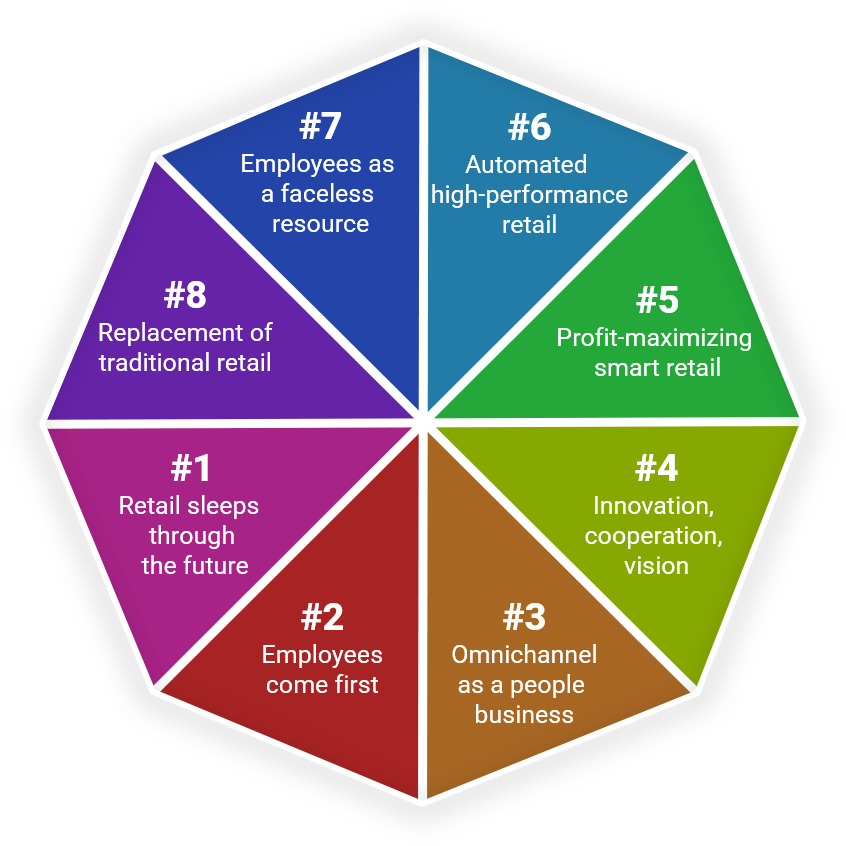
Map of the Future
The eight scenarios span the space of possibilities for the future world of work in retail:
- Retail sleeps through the future (Scenario 1): Retail fails to adapt, clinging to traditional structures and becoming increasingly unattractive both as an employer and to customers. A lack of innovation, limited digitalisation and a weak corporate culture cause the sector to lose staff and customers alike.
- Employees come first (Scenario 2, “Caring Emma”): A consistent focus on employee satisfaction sustains traditional brick-and-mortar retail. Retailers prioritise employees, personal advice and a corporate culture that is reflected in everyday practice. Modern HR practices and working conditions tailored to individual needs make retail an attractive employer despite limited automation.
- Omnichannel as a people business (Scenario 3): In an increasingly technology-driven retail sector, digital technologies support employees and create a seamless omnichannel experience without pushing people into the background. Strategic HR management, new skills profiles and innovative retail formats secure the competitiveness of brick-and-mortar retail.
- Innovation, cooperation, vision (Scenario 4): A holistic approach to HR closely integrates employee development, corporate culture and business strategy, making them central to success. Guided by a clear vision and a strong focus on employees, retail combines innovation, attractive working conditions and a strong employer brand to secure its long-term viability.
- Profit-maximising smart retail (Scenario 5): Modern technologies and intelligent automation improve efficiency and profitability, while employees take on more demanding tasks. Digitalisation is used consistently without removing people entirely from value-creation processes.
- Automated high-performance retail (Scenario 6): Automation and artificial intelligence shape almost every retail process and significantly reduce the need for traditional sales roles. Efficiency and standardisation take priority, with little emphasis on employees, while the strategic importance of HR and personal interaction declines.
- Employees as a faceless resource (Scenario 7): Persistent shortages of skilled workers make staff availability the key constraint on retail. Companies focus primarily on recruiting and retaining staff, while individual development and corporate culture become secondary to securing the workforce they need.
- Replacement of traditional retail (Scenario 8): Digital platforms, automation and new business models displace large parts of traditional brick-and-mortar retail. The role of sales staff declines sharply as value creation and employment shift into digital and technology-driven areas.
The Map of the Future shows that the scenarios differ primarily along four strategic core dimensions: the retail sector’s openness and capacity for innovation, the degree of automation, the role of employees and the strategic importance of HR. This reveals which future visions share similar development patterns and which fundamental alternatives companies should consider when defining their strategic direction.
The most positively assessed futures combine innovation, digital support and a consistent focus on employees. Scenario 4, “Innovation, cooperation, vision”, emerges as a particularly desirable future. Its holistic approach to HR brings together employee development, corporate culture and modern technologies to strengthen the competitiveness of retail. By contrast, scenarios in which HR loses importance or retail fails to respond to change represent critical development pathways, with substantial risks to employer attractiveness and long-term viability.
The study provides retailers with a frame of reference for the long-term development of their HR and business strategies. It helps them systematically consider different future developments, assess the implications of technological and social change at an early stage, and develop robust strategies for recruitment, skills development, leadership and organisational development. The scenarios thus provide a shared understanding of possible futures and a basis for strategic dialogue about tomorrow’s world of work in retail.