Mobility moves us – not only in the literal sense, but emotionally as well. The demands placed on our means of transport are diverse, as are public views on how mobility should be organised. The future of mobility has become a mainstream societal issue. In metropolitan areas in particular, today’s level of traffic is creating clear tensions, whether through environmental impacts or time lost in congestion. The topic is especially relevant because of the diversity of influences, the range of possible solutions and, not least, the opportunities and risks involved.
Against this backdrop, ScMI AG joined forces with ten partner companies to explore the future of urban mobility. Deutsche Bahn Connect GmbH, BMW Motorrad, Robert Bosch GmbH, hannoverimpuls GmbH, Hermes Germany GmbH, Innovationszentrum Niedersachsen GmbH, KNORR-BREMSE Systeme für Nutzfahrzeuge GmbH, MAN Truck & Bus AG, NTT DATA Deutschland GmbH and REWE Group brought a broad range of perspectives to the scenario process. The result is a study that not only presents differentiated visions of future urban mobility, but also highlights far-reaching implications for a wide range of players across the mobility system.
The eight scenarios offer possible answers to key questions relating to technology, policy and, not least, society.
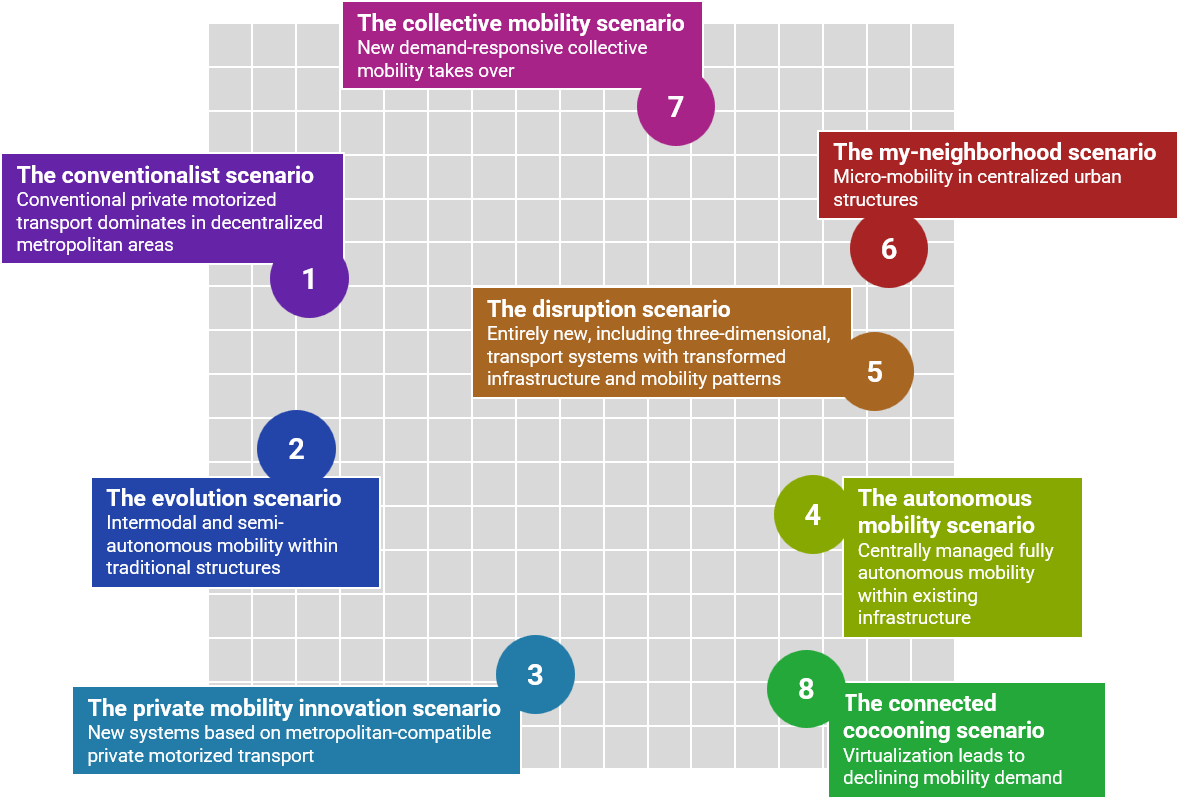
The eight scenarios address numerous uncertainties across the mobility system – from technological development and acceptance, through environmental and transport policy, to the mobility patterns of urban populations. Together, they create a varied set of meaningful future visions. Here is an initial glimpse into the mobility worlds of tomorrow:
- The conventionalist scenario – Keeping What Works (Scenario 1): Established mobility services remain in place, while innovations attract little acceptance. Private motorised transport continues to dominate, and investment in new infrastructure or mobility models remains the exception.
- The evolution scenario – Everything Stays the Same, Only Better (Scenario 2): Mobility becomes more comfortable and customer-oriented, driven mainly by private-sector innovation. Policy, however, remains tied to existing spatial and infrastructure concepts, preventing fundamental change.
- The private mobility innovation scenario – Technology as an Engine of Progress (Scenario 3): Technological innovation advances private motorised mobility, from automated vehicles to alternative powertrains. New business models emerge, but the mobility market also becomes increasingly complex.
- The autonomous mobility scenario – Autonomous Cities, Autonomous Transport (Scenario 4): Metropolitan areas actively redesign mobility around connected collective transport and autonomous systems. Modern infrastructure and high technology acceptance enable more efficient traffic flows and better environmental quality.
- The disruption scenario – Nothing Stays the Way It Was (Scenario 5): A profound mobility transition fundamentally changes transport, infrastructure and business models. Automated systems, air mobility and digital connectivity become defining features of urban life.
- The my-neighborhood scenario – Rediscovering What Is Close By (Scenario 6): Work, shopping and leisure shift more strongly into the immediate neighbourhood. Micromobility, short distances and digitalisation reduce the need to travel and strengthen local districts.
- The collective mobility scenario – Collective Transport before Individual Transport (Scenario 7): Public transport gains significantly in importance as individual car use is increasingly pushed out of city centres. This fundamentally changes infrastructure requirements and the automotive industry.
- The connected cocooning scenario – Physical Mobility Is Substituted (Scenario 8): Digitalisation replaces part of physical mobility as work, shopping and communication increasingly take place virtually. Transport demand declines, while mobility providers adapt their business models to changing needs.
After the scenarios had been developed, the future visions were assessed in terms of the present situation, the expected future and the preferred future. A clear development trend emerged: traditional mobility worlds are closest to today’s situation, while scenarios featuring autonomous, connected and integrated mobility solutions are considered particularly plausible for the future. At the same time, the assessment shows that several development paths remain conceivable and that different combinations of technology, regulation and social change can lead to viable mobility systems.
The scenarios provide a strategic basis for systematically analysing future opportunities and risks, testing existing strategies for future robustness and developing robust courses of action. Companies, mobility providers, municipalities and policymakers can use the future visions to derive development paths, assess new business models and identify changes in the mobility system at an early stage. In this way, the scenarios support the proactive shaping of urban mobility.