The study was developed as part of the long-standing collaboration between the EHI Retail Institute and ScMI AG. It began with the question of how retail foodservice could evolve in an environment shaped by changing consumer habits, digitalisation, skilled-labour shortages, sustainability, urbanisation and new foodservice concepts. The aim was not to predict a single future, but to outline several plausible development pathways and thereby provide a sound basis for strategic decisions.
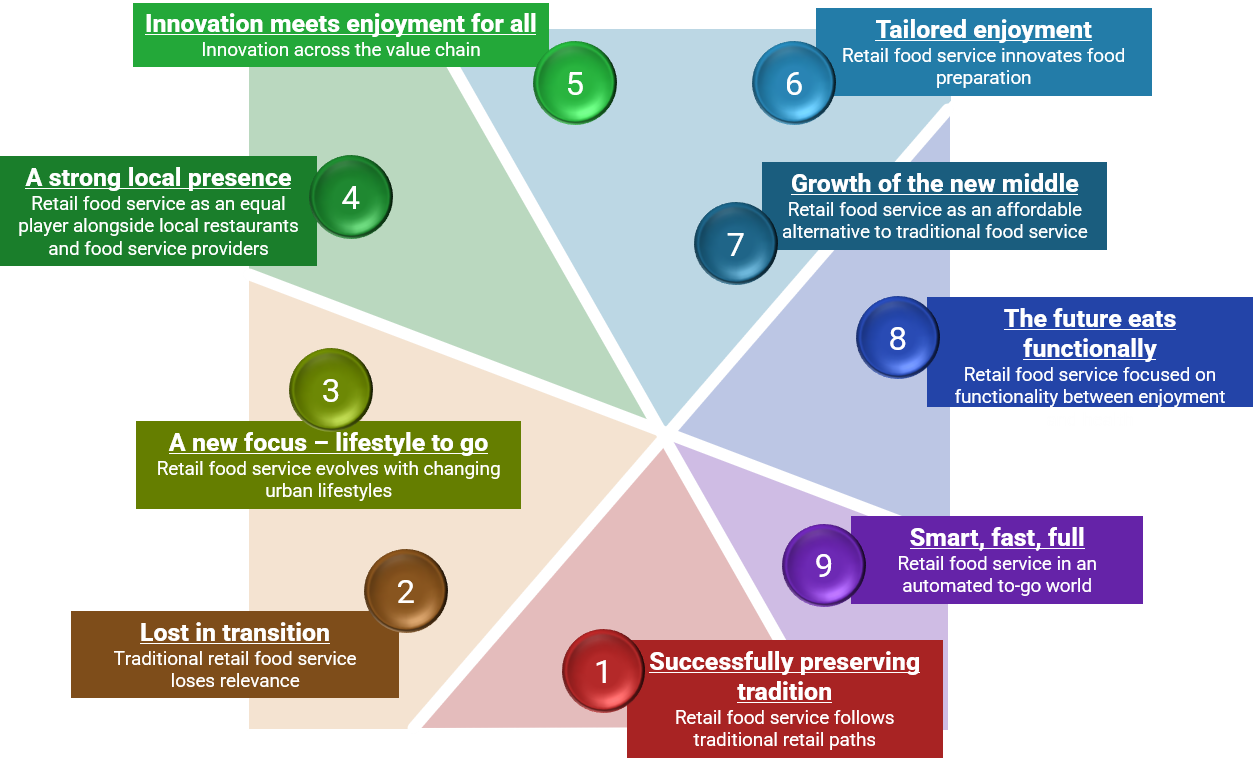
In a multi-stage scenario process, an interdisciplinary team comprising retailers, foodservice experts, and partners from industry and services developed nine consistent future scenarios. The process focused on key uncertainties such as the future importance of experience, lifestyle and enjoyment, the degree of automation and digitalisation, and developments in price levels, on-premise consumption and growth. The resulting map of the future positions the scenarios according to their similarities and differences and makes the full future space of retail foodservice visible.
• Successfully Preserving Tradition (Scenario 1): Retail foodservice continues largely along today’s structures and primarily remains a way of increasing footfall in brick-and-mortar retail.
• Lost in Transition (Scenario 2): A lack of innovation and limited focus on customer experience cause retail foodservice to lose importance increasingly.
• A New Focus – Lifestyle to Go (Scenario 3): Premium takeaway offerings and urban lifestyles drive growth, while conventional on-premise foodservice stagnates.
• A Strong Presence on Site (Scenario 4): Retail foodservice establishes itself as an equal player in the on-premise foodservice market and reaches new target groups.
• Innovation Meets Enjoyment for Everyone (Scenario 5): Digitalisation and innovation across the entire value chain create attractive food experiences for different customer groups.
• Tailored Enjoyment (Scenario 6): AI and modern technologies enable individually tailored foodservice offerings with a high experiential value.
• Growth of the New Middle (Scenario 7): Retail foodservice successfully positions itself as a high-quality yet price-conscious alternative to conventional restaurants and foodservice providers.
• The Future Eats Functionally (Scenario 8): Functional nutrition and personalised foods become significantly more important and fundamentally reshape foodservice offerings.
• Smart, Fast and Satisfying (Scenario 9): Fully automated takeaway concepts shape retail foodservice in an increasingly digitalised market.
The subsequent scenario assessment shows that today’s retail foodservice is still strongly characterised by relatively traditional concepts. By 2035, however, the experts predominantly expect futures with substantially more digitalisation and automation, combined with a stronger emphasis on experience, enjoyment and social interaction. These growth-oriented scenarios are also rated as particularly desirable. The results therefore highlight both the opportunities available to the sector and the continuing uncertainty surrounding its precise development pathway.
The study treats the scenarios as thinking tools for the strategic development of retail foodservice. They help retail and service companies challenge existing assumptions, derive innovations and develop robust strategies for different future developments. Some companies are already using the scenarios to inform their strategic direction, long-term decisions and the further development of their business models.