Mobility is a key location factor for the future of rural regions. It influences their attractiveness as places to live and do business, access to jobs, education and healthcare, and participation in societal life. While future visions for mobility often focus on urban areas, this study deliberately addresses the particular challenges and potential of rural regions.
The study was developed in a joint scenario process involving ScMI AG, BMW Motorrad, LVM Insurance, the Central German Transport Association (MDV), Kommunale Verkehrsgesellschaft Lippe (KVG), the Leipzig district authority and the Lippe district economic development agency. Several workshops brought together different perspectives on rural mobility and used them to develop eight consistent future scenarios.
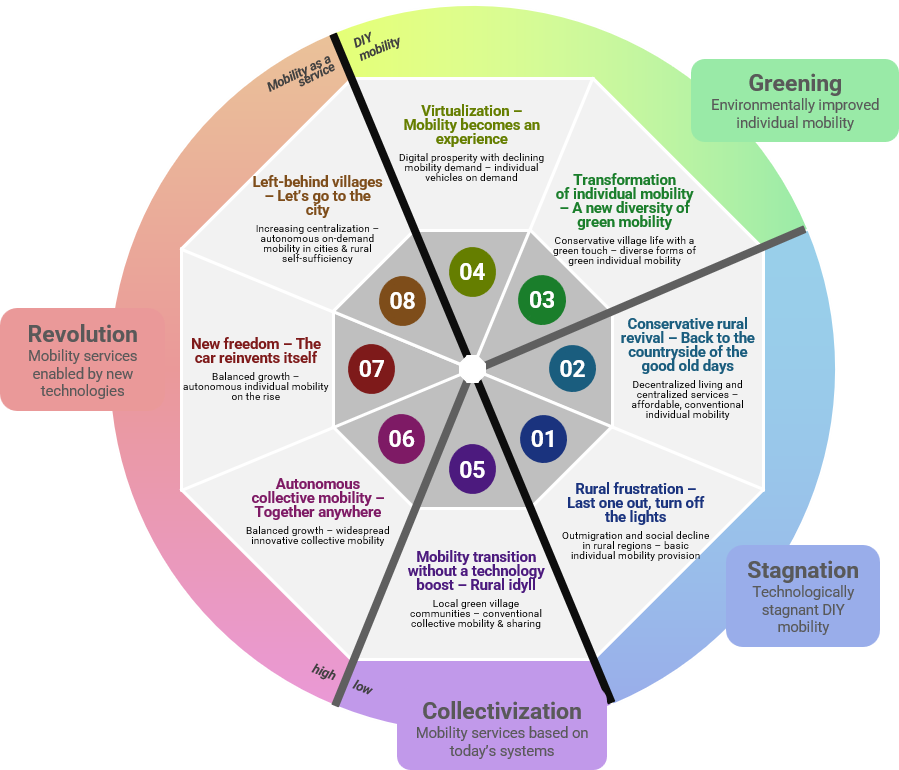
The scenarios are positioned on a Map of the Future. Two fundamental core dimensions structure the eight future visions and reveal similarities, differences and possible development paths: the future mobility paradigm between individual mobility and Mobility as a Service, and the dynamics of technological development.
Scenarios
- Rural frustration – Last one out, turn off the lights (Scenario 1): Economic decline and outward migration weaken rural areas. The withdrawal of public mobility services increases dependence on improvised individual solutions.
- Conservative rural revival – Back to the countryside of the good old days (Scenario 2): Rural living becomes more attractive, but remains strongly centred on private cars. Living in the countryside and working in urban centres shape everyday mobility.
- Transformation of individual mobility – A new diversity of green mobility (Scenario 3): Sustainable propulsion technologies and new forms of individual mobility become established. Micromobility and electric vehicles complement the conventional car.
- Virtualization – Mobility becomes an experience (Scenario 4): Digitalisation reduces many everyday journeys through remote working and digital services. Mobility is needed less often and is used mainly for leisure and special occasions.
- Mobility transition without a technology boost – Rural idyll (Scenario 5): High-performing public transport forms the backbone of sustainable mobility. Sharing services and micromobility complement conventional public transport.
- Autonomous collective mobility – Together anywhere (Scenario 6): Autonomous, connected mobility services create new opportunities for comprehensive collective mobility. Public and digital mobility services become closely integrated.
- New freedom – The car reinvents itself (Scenario 7): Autonomous private vehicles and robo-taxis enable highly flexible mobility. The boundaries between mobility, work and leisure become increasingly blurred.
- Left-behind villages – Let’s go to the city (Scenario 8): Technological innovation concentrates on urban centres. Rural areas fall behind in mobility development and remain dependent on conventional individual mobility.
The study assesses all eight scenarios in terms of their proximity to the present, future relevance and popularity. The results show that no future vision can be ruled out, although clear trends towards technological innovation and new forms of mobility are emerging. At the same time, expectations and preferences for individual scenarios differ considerably.
The scenarios show that the future of rural mobility depends on more than new transport technologies alone. Economic development, demographic change, digitalisation, sustainability and political conditions are equally important. The interaction of these factors will determine whether individual or collective mobility solutions dominate and how attractive rural regions remain as places to live and do business.
The scenarios provide a frame of reference for strategic decisions by municipalities, transport companies, regions and businesses. They support the early consideration of different development paths, the development of robust mobility strategies and the derivation of concrete measures for infrastructure, mobility services and regional development under uncertainty.