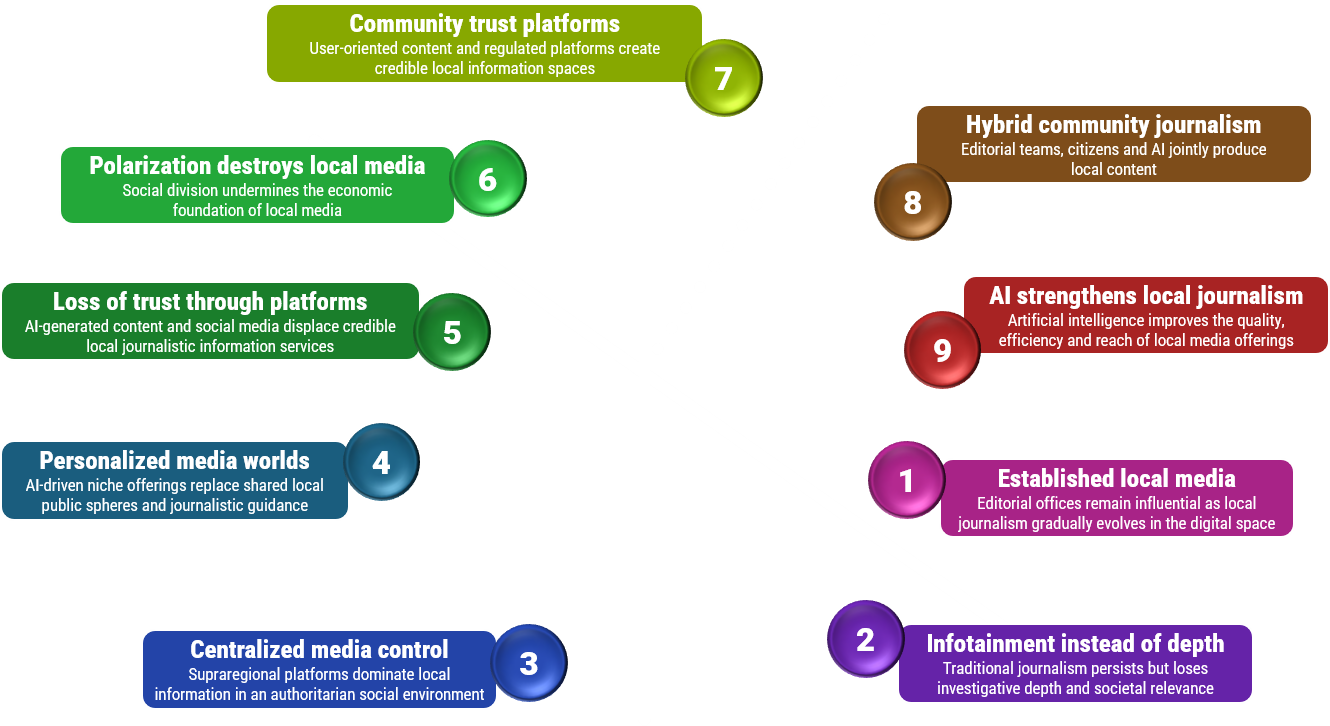
The working paper builds on the results of a Future School at Nuremberg Tech – Georg Simon Ohm. As part of the course, students worked with practitioners and ScMI AG to develop initial future visions for local journalism. These were subsequently refined and expanded through an in-depth scenario analysis into a coherent Map of the Future comprising nine scenarios. The work was based on eight core dimensions covering, among other issues, social cohesion, political participation, platform power, media literacy, the use of artificial intelligence and the future role of journalistic work.
The nine scenarios describe different development pathways for local journalism:
- Established local media (Scenario 1): Quality journalism maintains its role as a central source of information and guidance for society and continues its gradual digital development.
- Infotainment instead of depth (Scenario 2): Entertainment and audience reach gain importance relative to investigative reporting, while traditional media structures remain in place.
- Centralized media control (Scenario 3): Platforms and large media groups dominate access to local information and weaken the independence of local newsrooms.
- Personalized media worlds (Scenario 4): Highly personalised information services increasingly replace shared local public spheres and journalistic guidance.
- Loss of trust through platforms (Scenario 5): AI-generated content and social media displace traditional journalistic offerings, weakening trust in local information and reducing its quality.
- Polarization destroys local media (Scenario 6): Social division undermines the economic and social foundations of local media.
- Community trust platforms (Scenario 7): Regulated platforms combine professional journalism with active community participation, creating new digital spaces built on trust.
- Hybrid community journalism (Scenario 8): Newsrooms, citizens and artificial intelligence jointly shape local information services.
- AI strengthens local journalism (Scenario 9): Artificial intelligence improves the efficiency, quality and reach of journalistic offerings, while humans retain editorial responsibility.
The working paper makes clear that the future of local journalism does not depend on technological innovation alone. Social trust, media literacy, regulatory frameworks and the role of digital platforms are equally important. The scenarios help media organisations, journalists and policymakers systematically explore alternative futures and develop robust strategies for tomorrow’s local journalism.