The study interprets right-wing populism less as a short-term crisis phenomenon than as an expression of deeper structural tensions. It identifies perceived losses of control, social and regional inequalities, cultural insecurity and eroding trust in political institutions as conditions that increase the appeal of simplified worldviews, exclusionary thinking and promises of authoritarian solutions.
The authors note, however, that discussions of right-wing populism are dominated by immediate concerns and reactive measures. “Our own short-term thinking enables right-wing populists to set the agenda, reshape public debate and create opportunities to gain power,” says Dr Alexander Fink, Chair of D2030 and co-author of the study. “Future scenarios allow us to identify long-term developments, recognise tipping points early and ultimately respond more strategically to the evident risks.”
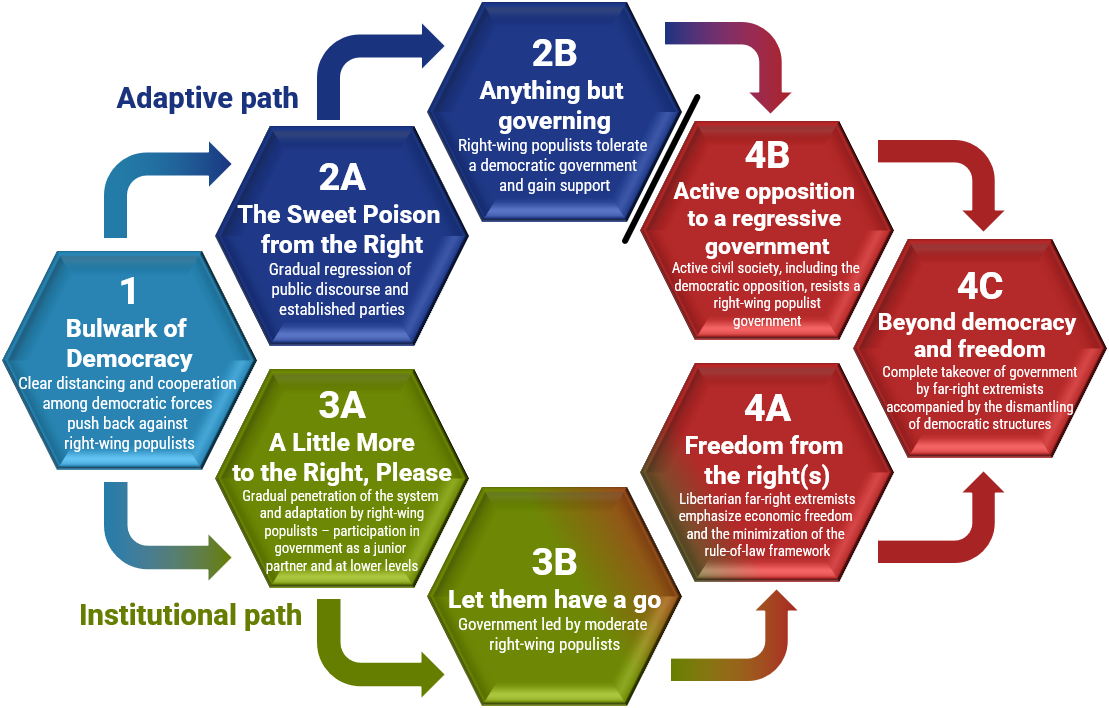
The study is based on a systematic, data-supported foresight process that produced eight scenarios. Their relationships are shown on a Map of the Future. Starting from a democratic baseline scenario, the study identifies two central dynamics:
- The adaptive pathway describes the gradual hollowing out of democratic culture. Institutions remain formally intact, but language, public discourse and political frames of reference shift. What begins as rhetorical accommodation can lead to the normalisation of right-wing populist narratives.
- The institutional pathway explores how right-wing populist actors gradually take on government responsibilities, initially at local level and as junior coalition partners, later at national level and in leadership roles. As their power grows, the separation of powers and fundamental rights come under pressure.
Within the study’s scenario framework, both pathways include transitions towards authoritarian transformation and ultimately culminate in an ethno-nationalist future beyond democracy and freedom. The authors argue that these scenarios and pathways illustrate how democracy is lost not in a single moment, but at tipping points that need to be recognised and understood early. At the same time, the study also describes routes from every scenario back towards liberal democracy.
The study is explicitly intended as a working resource for policymakers, public administration, civil society and education stakeholders. It aims to broaden debate on right-wing populism, identify scope for action and support long-term strategies for strengthening democratic resilience.