The project was prompted by growing structural disruption and questions about how the global economy, world order and globalisation might change over the long term. In 2021, ScMI conducted an open, international scenario process. Across four online workshops, participants identified 79 influencing factors, consolidated them into 23 key factors and developed alternative future projections for each. These projections were then combined into eight scenarios using a consistency analysis. Experts from more than 20 countries participated in the development process, and the group was substantially expanded for the subsequent assessment. The process combined systematic scenario analysis with global, interdisciplinary dialogue.
The Map of the Future is structured by two fundamental dimensions. The horizontal axis runs from continued Western leadership to a substantial shift in the global centre of power towards Asia. The vertical axis distinguishes between multilateral cooperation and a world of growing division and conflict. Further core dimensions shape the scenarios: the role of state and non-state actors, the future of globalisation, cultural values and trust in public institutions, the global distribution of prosperity, and the intensity of systemic rivalry. The map therefore shows not only individual future visions, but also their relationships, transitions and fundamental differences.
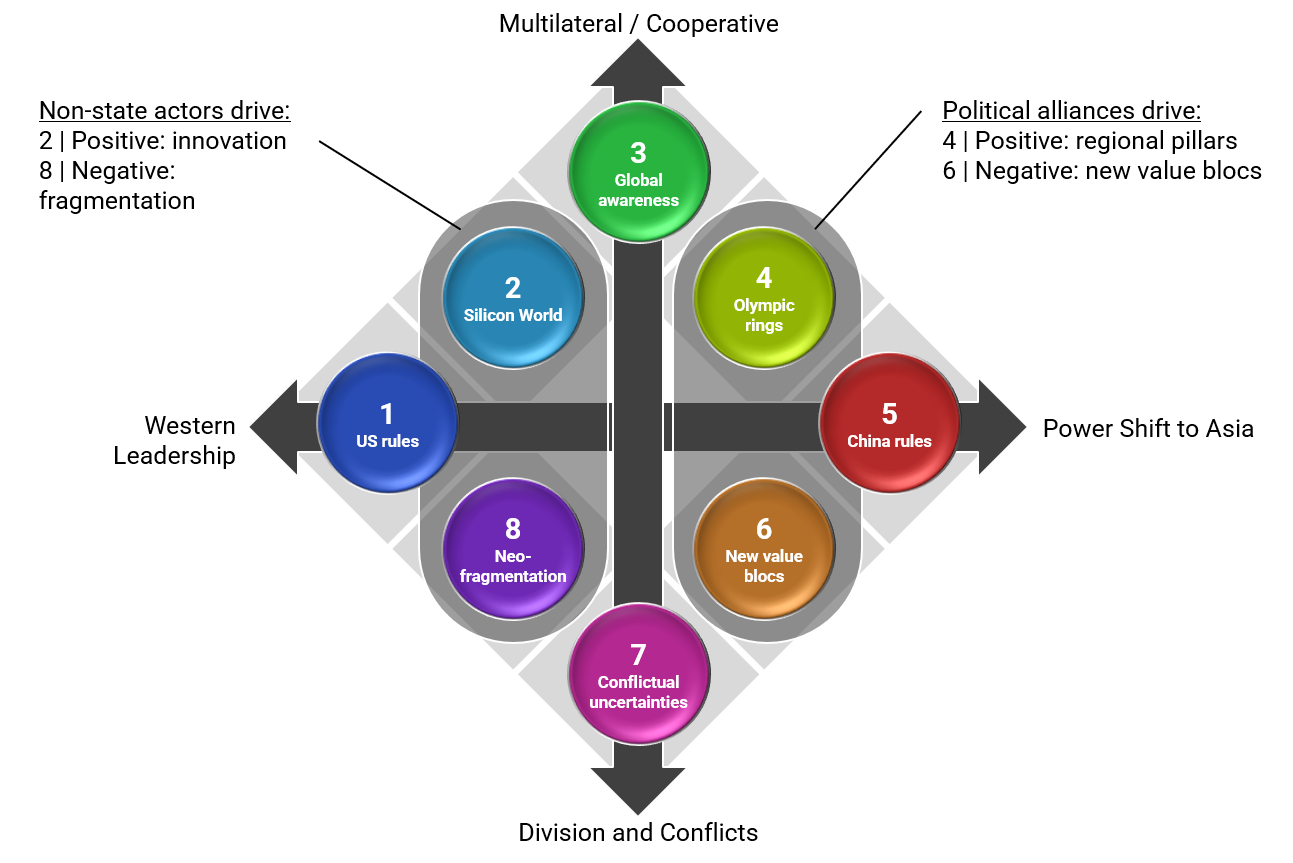
Scenario overview
- US rules (Scenario 1): The United States maintains or re-establishes its global leadership. The world remains Western-led, but Europe primarily acts as a dependent junior partner, while China falls behind economically and technologically.
- Silicon World (Scenario 2): Global technology companies and digital ecosystems assume social responsibility and gain greater trust than traditional political institutions. New glocal communities emerge, combining global connections with local identities, and non-state actors help shape the world order.
- Global awareness (Scenario 3): A strong sense of global responsibility leads to multilateral cooperation, powerful international institutions and concerted climate policy on a planetary scale. China opens up, the Global South gains influence and global inequality declines.
- Olympic rings (Scenario 4): The world is organised into several strong geo-regional spheres of influence. The United States, China, Europe and other powers pursue their own approaches, but cooperate on key issues and learn from one another.
- China rules (Scenario 5): China becomes the leading global power and shapes political, economic and technological rules. Western values lose influence, while Europe loses significance between competing centres of power.
- New value blocs (Scenario 6): The world divides into a Western democratic bloc and an authoritarian bloc shaped by China. A new Cold War defines politics, technology, supply chains and economic relations.
- Conflictual uncertainties (Scenario 7): A world without clear leadership emerges, marked by numerous lines of conflict. States, regions and groups compete, global institutions lose effectiveness, and a small digital elite shields itself from broader economic and social decline.
- Neo-fragmentation (Scenario 8): Trust in states, politics and public institutions erodes. Non-state actors, digital network monopolies and regional interests gain power, while social cohesion and overarching governance weaken.
Global assessment and interpretation
Between September 2021 and January 2022, 204 experts from 66 countries assessed the scenarios. Their contributions brought together perspectives from all continents and numerous geopolitical and economic regions. Respondents assessed the key differences between the scenarios in terms of their proximity to the present, the expected future in 2035 and their personally preferred future. The study treats these findings not as a representative forecast, but as a broad international frame of reference that reveals regional differences and competing expectations about the future.
The assessment identified “New value blocs” as a continuity scenario closely connected to respondents’ views of both the present and the expected future. It describes a world of growing systemic rivalry and, already in 2022, highlighted the risks associated with the continuation of existing developments. However, expectation scores for all eight scenarios were relatively close, underlining the considerable uncertainty surrounding global development.
Regional differences were pronounced. Western respondents placed greater emphasis on systemic conflict and bloc formation, whereas many participants from Asia and the Global South anticipated more cooperative, multipolar developments. Respondents outside the West were also more likely to view companies and non-state actors as positive drivers. Within this survey, the narrative of comprehensive systemic rivalry therefore emerged primarily as a Western perspective.
Preferences for the future were more consistent across regions. Respondents emphasised multilateral cooperation, global responsibility, sustainable transformation and a stronger role for the Global South. The detailed scenario assessments are documented in the original study. The findings reveal a central tension: expectations tended towards a more conflict-prone future, while respondents across regions expressed a clear preference for cooperation and transformation.
Further development of the New Global scenarios
The New Global scenarios have continued to evolve since their publication. In 2022, a Ukraine stress test examined whether Russia’s war of aggression fundamentally challenged the scenario architecture. The analysis concluded that the war acted less as an entirely unexpected disruption than as an accelerator of developments already reflected in the scenarios, particularly systemic rivalry, bloc formation and fragmentation. The underlying scenario structure thus remained applicable even in the face of a profound geopolitical shock.
For the 2026 book “Szenario-Management und Strategic Foresight” (Scenario Management and Strategic Foresight), the scenarios were reviewed, updated and expanded again. The review focused on three areas: changing patterns of globalisation and free trade, a wider spectrum of political alliances, and the changing position of Europe and the wider Western community of states. The continuing war in Ukraine, the increasing fragmentation of trade and technology networks, and Donald Trump’s re-election prompted a more differentiated treatment of the original contrast between a cooperative multipolar world and a confrontational bipolar world.
The revision introduced additional future visions and refined existing ones. Alongside a cooperative multipolar order and a new Cold War, the framework now considers “Managed Rivalry”, in which systemic competition is contained, and “Clash of Many”, characterised by shifting alliances, transactional partnerships and an absence of binding rules.
Europe’s role was also explored separately and in greater depth. Four sub-scenarios examine Europe under the US security umbrella, a geopolitically weak and fragmented Europe, Europe as an independent global actor, and Europe as a strong second pillar of the West.
Combining the updated global scenarios with the four European sub-scenarios created a more differentiated frame of reference comprising numerous scenario configurations. It enables systematic analysis of both global shifts in power and Europe’s scope for action under each configuration. Other international scenario studies can also be positioned within this framework, helping to identify potential blind spots. This further development builds on the robustness of the New Global architecture and extends it into a flexible tool for Strategic Foresight in an increasingly fragmented world.
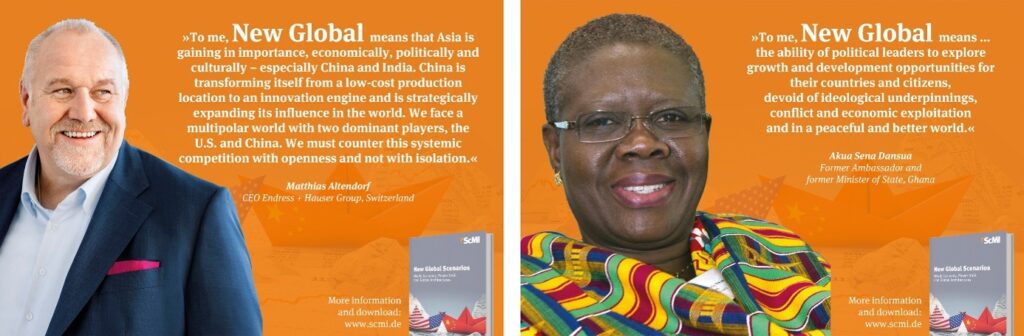
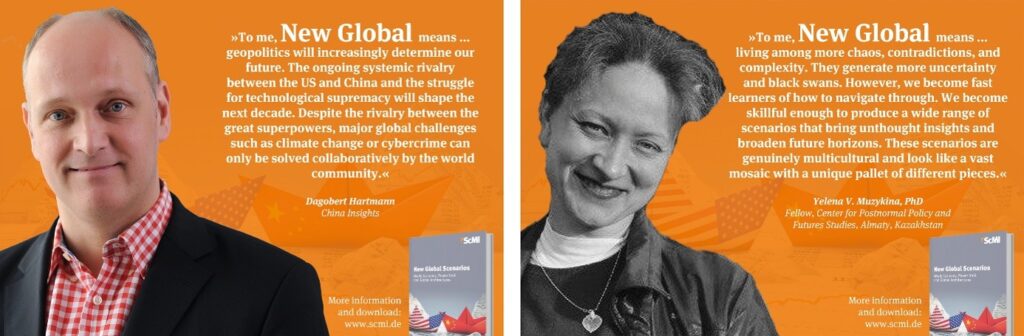
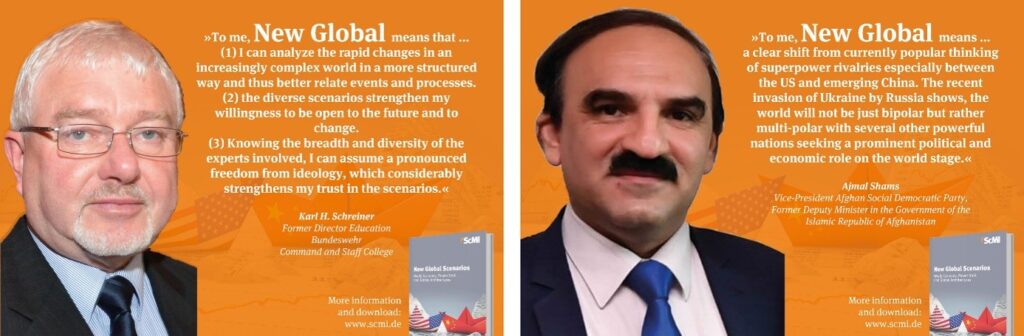
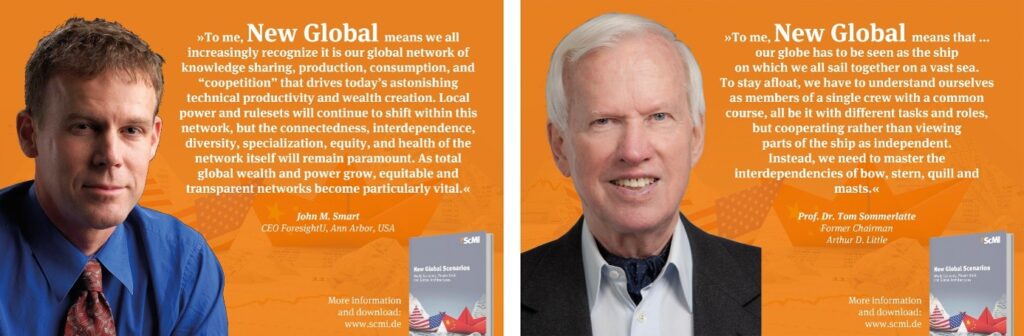
Expert feedback from the New Global scenario team: