As part of a project initiated by the German Environment Agency, scenarios were developed to explore the conditions surrounding Germany’s National Sustainability Strategy and identify sustainable strategic approaches for leisure, food and housing.
By definition, sustainability means preserving future viability in the decisions we make today. But what happens if global conditions change? How must sustainable concepts then be adapted? And which sustainable responses can be developed for specific fields of action? An interdisciplinary project initiated by the German Environment Agency sought answers to these questions.
Germany’s National Sustainability Strategy, first presented by the Federal Government in 2002, is entitled Perspectives for Germany. It is intended as a foundation both for policy reform and for changes in the behaviour of businesses and consumers. The guidelines formulated in the strategy cover intergenerational equity, quality of life, social cohesion and international responsibility.
As part of the strategy’s continuing development, the Federal Government regularly publishes progress reports and indicator reports. A sustainability impact assessment introduced in 2009 requires all federal ministries to review and document the long-term effects of proposed legislation on sustainable development.
Five scenarios for Germany’s external context in 2040
The project began by examining possible conditions for the National Sustainability Strategy. More specifically, it asked how Germany’s external context could change through to 2040. A multi-stage process based on Scenario Management produced five possible external scenarios:
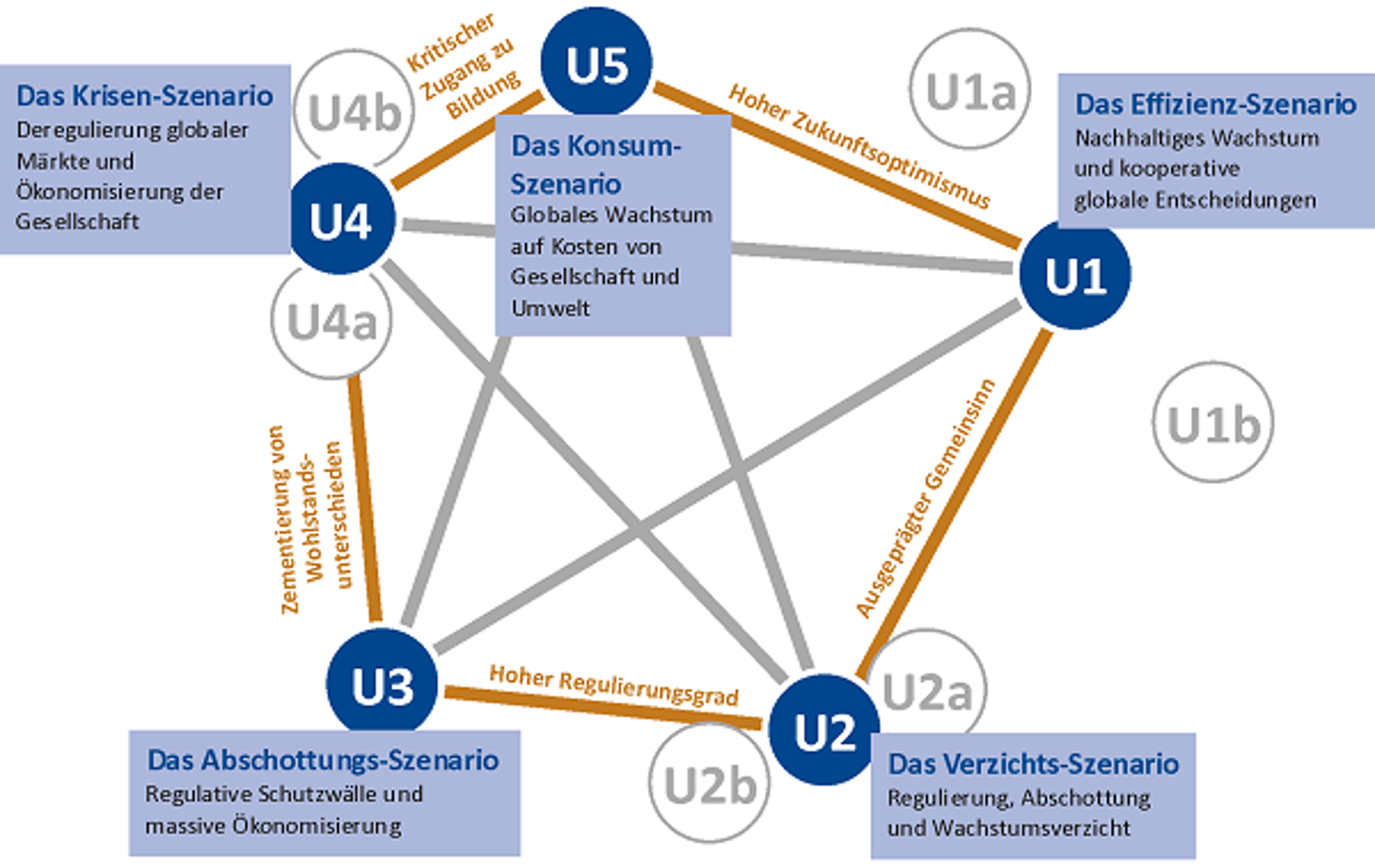
- Efficiency Scenario – Sustainable Growth and Cooperative Global Decision-making (Scenario 1): Sustainability is advanced through technological innovation, responsible economic activity and international cooperation. Efficiency gains and global collaboration provide the foundation for prosperity and effective environmental protection.
- Sufficiency Scenario – Regulation, Isolation and Rejection of Growth (Scenario 2): Deliberate restraint in consumption, a sense of community and regional economic cycles shape society and the economy. Sustainability arises primarily through changing lifestyles and more strongly regulated development.
- Isolation Scenario – Regulatory Barriers and Extensive Commercialisation (Scenario 3): National isolation, economic competition and societal division constrain sustainable innovation. Environmental and sustainability issues lose importance.
- Crisis Scenario – Deregulated Global Markets and the Commercialisation of Society (Scenario 4): Economic crises, social conflict and scarce public resources limit the scope for action. Sustainability recedes behind short-term economic interests.
- Consumption Scenario – Global Growth at the Expense of Society and the Environment (Scenario 5): Economic growth and individual consumption dominate development. Sustainability considerations play a subordinate role, while environmental pressures and societal inequalities increase.
The five scenarios were then assessed on the basis of their 22 key factors. The analysis produced two conceivable long-term expected-future spaces. A critical external development path is dominated by Scenarios 3 and 4 and would be characterised by externally determined lifestyles and limited societal participation in growing prosperity. This contrasts with a preferred external development path based primarily on Scenarios 1 and 2. Its defining features are a strong sense of community, the high importance of information in purchasing decisions, and strong global awareness of environmental and sustainability issues.
Using solution scenarios to reveal different paths to sustainability
Current debates already show that there are different ways of achieving greater sustainability in politics, business and society. This range of possibilities expands further when alternative external developments are considered at the same time. An innovative element of the project was therefore the development of alternative pathways for shaping a sustainable future. Three working groups developed solution scenarios for sustainable leisure, sustainable housing and neighbourhoods, and sustainable food.
- Sustainable leisure: The scenarios for sustainable leisure focus primarily on the share of leisure in everyday life, societal participation and the degree of material orientation. The scenario assessment showed that a transformation of the broader external context could also enable leisure scenarios currently regarded as less likely – involving reduced mobility, community values and sustainable consumption concepts – to become established. Overall, however, the findings also showed that leisure remains an area in which sustainability concepts are comparatively underdeveloped.
- Sustainable housing and neighbourhoods: The scenarios for sustainable housing and neighbourhood design depend primarily on society’s understanding of nature and the active role of the construction industry. Here too, the findings showed that sustainability concepts close to the present – for example, concepts designed for highly mobile societies or simplified urban structures – are particularly well suited to the critical external development path.
- Sustainable food: The scenarios for sustainable food comprise three levels: organic agriculture driven by informed consumers, regional agriculture, and food sovereignty involving certain restrictions. Under the preferred external development path, many different solution concepts remain conceivable, whereas under a critical external context the sustainable solution space narrows to global innovation concepts or self-sufficiency scenarios.
Different forms of sustainability across individual fields of action?
Overall, the project presented a predominantly critical view of the present: scenarios close to the current situation correspond closely to the expected future, but only weakly to the preferred future. The outlook differs between the individual fields. In food – and partly in housing – sustainability already plays a significant role, and preferred futures are also considered plausible. In leisure, by contrast, sustainability remains visibly underdeveloped.
The scenarios and the methodology can be used in a variety of ways. The five external scenarios can serve as a basis for cross-cutting dialogue and as a tool for robustness checks of existing sustainability concepts. The different solution scenarios also enable more specific assessments within the fields considered. A summary of the study findings is available here.