Healthcare is one of the sectors most profoundly affected by digitalisation, in terms of both opportunities and risks. Data-driven approaches enable new, personalised therapies and significantly improved prevention. At the same time, they put existing healthcare systems under pressure, increase transparency, including for large technology companies, and could ultimately lead to excessive commercialisation. No single reliable forecast is possible. Instead, a range of possible developments needs to be explored.
More than 50 experts from different stakeholder groups took part in a systematic online scenario process, supported by Deloitte, Novartis and the Canton of Zurich. Together, they developed ten scenarios describing possible futures for the Health Data Ecosystem. The scenarios differ primarily in the extent of technological change driven by AI and personalised medicine, and in the degree of cultural and process-driven change in healthcare. These two core dimensions define four overarching scenario groups:
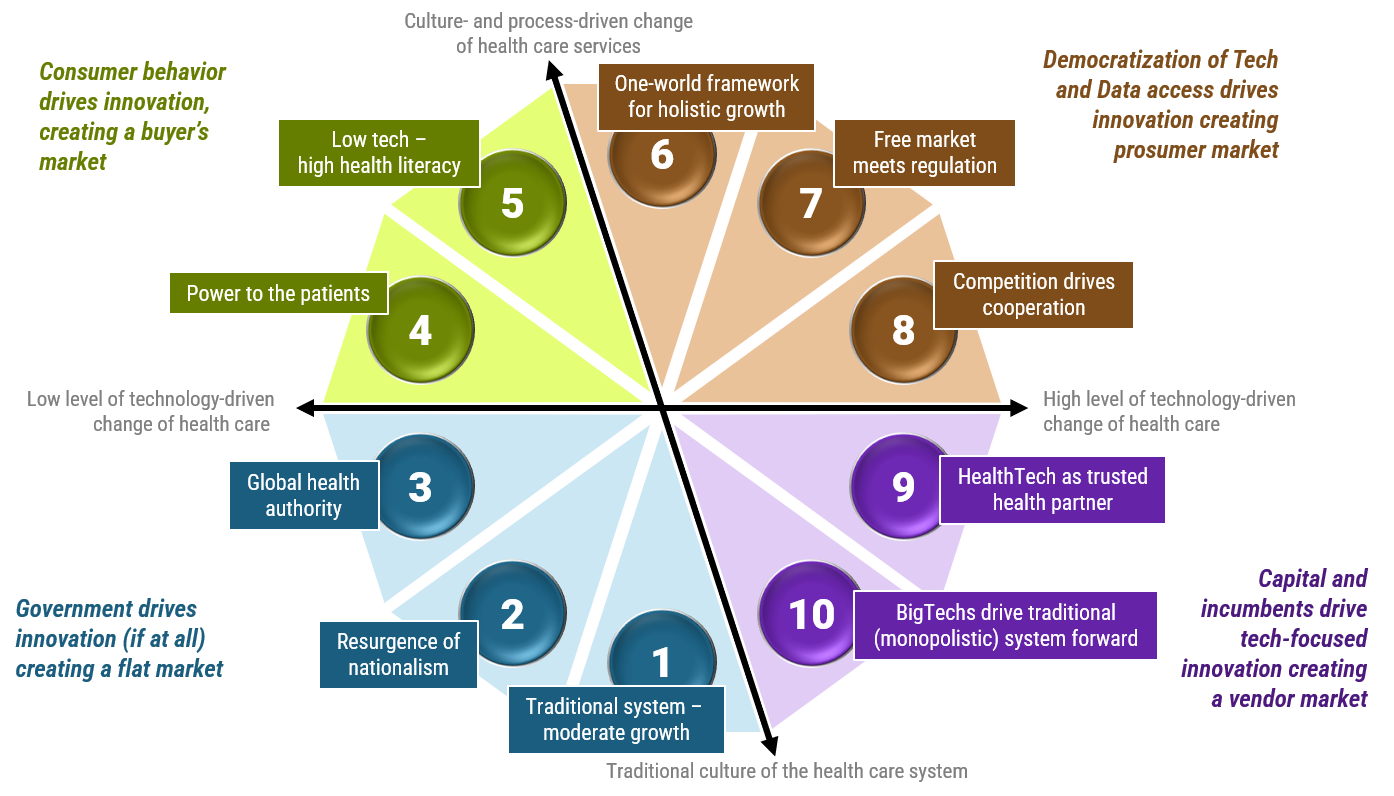
- Traditional Actors and the Public Sector in a Slow-Moving Market (Scenario Group 1): With little technological or cultural change, healthcare develops only incrementally. Established actors, including the public sector, continue to dominate, and innovation often fails to gain traction. A lack of connectivity means that health data frequently remains confined to individual domains. This group comprises three scenarios: Traditional system – moderate growth (Scenario 1A), Resurgence of nationalism (Scenario 1B) and Global health authority (Scenario 1C), in which health data is treated as a public good.
- Customer Behaviour as the Innovation Driver in a Buyer’s Market (Scenario Group 2): Technology advances only gradually, while citizens want to move more quickly towards taking an active role in managing their own health. This change in behaviour drives innovation in processes and business models. The two scenarios differ primarily in the stakeholders leading this change: Power to the patients (Scenario 2A) and Low tech – high health literacy (Scenario 2B), in which prevention is a key driver.
- Democratisation of Technology and Data Access in an Ecosystem-Driven Market (Scenario Group 3): People increasingly take charge of their own healthcare, while breakthroughs in data science revolutionise medicine. This democratisation of health ecosystems can take three forms: One-world framework for holistic growth (Scenario 3A), which reinvents healthcare through an integrated network; Free market meets regulation (Scenario 3B), which creates a level playing field; and Competition drives cooperation (Scenario 3C), in which collaboration develops within a fragmented market.
- Capital and Technology as Innovation Drivers in a Seller’s Market (Scenario Group 4): Technology takes a major leap forward, and healthcare becomes increasingly data-driven. Providers and regulators struggle to keep pace with the accelerating changes. The key question is whether new entrants or established actors shape this transformation. This group comprises two scenarios: HealthTech as trusted health partner (Scenario 4A) and BigTechs drive traditional (monopolistic) system forward (Scenario 4B).
A specific health data architecture was outlined for each of the ten scenarios. These architectures address issues such as data ownership, the openness of infrastructure, trust in health data, standardisation and monetisation, and the breadth of the value chain. An initial scenario assessment also highlighted stakeholders’ desire for cultural change within healthcare. All findings are summarised in a study report available as a free download.
The DayOne scenario project continued beyond the development of the Health Data Scenarios. In a second project phase, the scenarios were stress-tested in stakeholder-specific workshops. These sessions examined specific questions through the lens of selected scenarios and enabled DayOne, ScMI and Blauen Solutions to validate the scenario assessment and identify further implications.