Looking at the news, it can often feel as though Germany is moving from one crisis to the next – navigating by sight and often without a shared destination. What is missing are compelling images of possible and liveable futures. Instead, the default is often simply to carry on as before – something previous generations believed too, until events took a very different course. Being blind to the future means forfeiting opportunities to shape it.
Yet Germany has the potential to do better. This is why Klaus Burmeister and Beate Schulz-Montag initiated the open-source D2030 project (“Germany 2030”), which aims to foster an ongoing dialogue about Germany’s future in Europe and the world. Scenarios and a Map of the Future form the basis of this dialogue, with ScMI AG contributing intensively as the methodological partner.
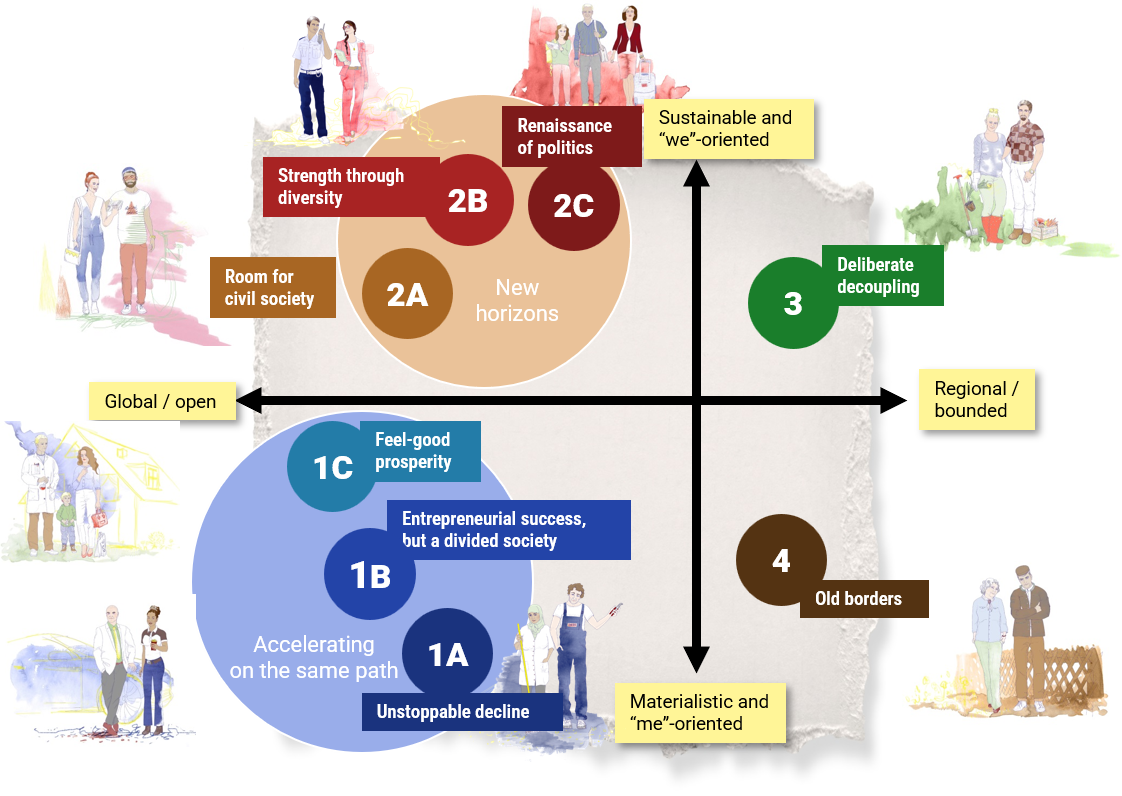
The Map of the Future contains eight scenarios, each based on 33 key factors whose possible developments were expressed through two or more dimensions. Analysis of this complex network revealed two main axes that can be understood through two core questions: (1) What is Germany’s attitude towards change and its willingness to cooperate globally? (2) How important are sustainability and civic engagement in Germany? Combining these two axes produces four basic scenarios: (1) Accelerating on the same path, (2) New horizons, (3) Deliberate decoupling and (4) Old borders. The first two basic scenarios are each differentiated into three sub-scenarios, resulting in eight future visions in total:
- Unstoppable decline (Scenario 1A): Germany falls behind in the digital transformation. Loss of prosperity, societal conflict and declining international competitiveness shape the future.
- Entrepreneurial success, but a divided society (Scenario 1B): The economy remains successful, but social inequality grows. Digitalisation and globalisation contribute to increasing social fragmentation.
- Feel-good prosperity (Scenario 1C): Economic growth, technological progress and strong competitiveness secure broad prosperity, while sustainability and active government lose importance.
- Room for civil society (Scenario 2A): An open, digitally connected society relies on individual responsibility, innovation and strong civil-society structures as the basis for societal development.
- Strength through diversity (Scenario 2B): Openness, European cooperation, sustainable economic activity and societal diversity strengthen Germany’s future viability.
- Renaissance of politics (Scenario 2C): A capable state actively shapes digitalisation, innovation and social balance, combining economic dynamism with societal responsibility.
- Deliberate decoupling (Scenario 3): Germany embraces sufficiency, regional economic cycles and sustainability, partially disengaging from global growth and competitive logics.
- Old borders (Scenario 4): Isolation, renationalisation and societal polarisation shape development. Digitalisation and globalisation are increasingly perceived as threats.
Assessment and strategic interpretation
After the scenarios had been developed, the future visions were assessed according to their proximity to the present, their expected development and their desirability. The Scenario 1 variants were considered closest to the present, particularly Entrepreneurial success, but a divided society. The expected-future space is broader: Scenarios 1B and 1C represent a continuation of established development patterns, while 2A and 2B indicate possible transitions towards more open, sustainable and collaborative futures.
The preferred-future space, by contrast, is clearly centred on the Scenario 2 family, New horizons. Strength through diversity, in particular, combines openness, social cohesion, sustainability and economic future viability. The assessment therefore points to a desired transition away from the present-oriented Scenario 1 futures and towards the Scenario 2 futures. Whether this transition will actually succeed remains uncertain, as the expected-future space also includes more problematic development paths.
The resulting guiding questions therefore focus on how such a transition could be shaped: How can courage for change be created? How can openness and global connectedness be combined with sustainability and social cohesion? And how can Germany avoid sliding into division, isolation or renationalisation?
Rethinking Germany – A Future for Everyone
The results of the scenario process were subsequently developed further and published by oekom verlag in the book Deutschland neu denken – Acht Szenarien für unsere Zukunft (Rethinking Germany – Eight Scenarios for Our Future). The book derives strategic guidelines for Germany’s future from the scenarios. Rather than focusing on individual policy measures, it identifies fundamental levers for future-ready development. The study shows that long-term challenges such as digitalisation, climate change and social cohesion can only be addressed if Germany actively shapes the future, remains open to change and strengthens public dialogue about the future. Strategic orientation does not come from rigid target visions, but from guiding questions that encourage different actors to develop shared answers.
The overarching narrative that emerges is A Future for Everyone. It deliberately links social cohesion with an open attitude towards change. Future readiness arises when as many people as possible are involved in shaping transformation and when openness, innovation and participation reinforce one another. Participation and openness to the future therefore become central conditions for a resilient and future-ready society.