The study was developed through a cross-industry scenario process involving leading companies from retail, logistics, industry and technology. It began by asking which technological, economic and societal developments would shape the use of artificial intelligence in retail through 2030. Relevant influencing factors and key factors were identified and combined into consistent future scenarios.
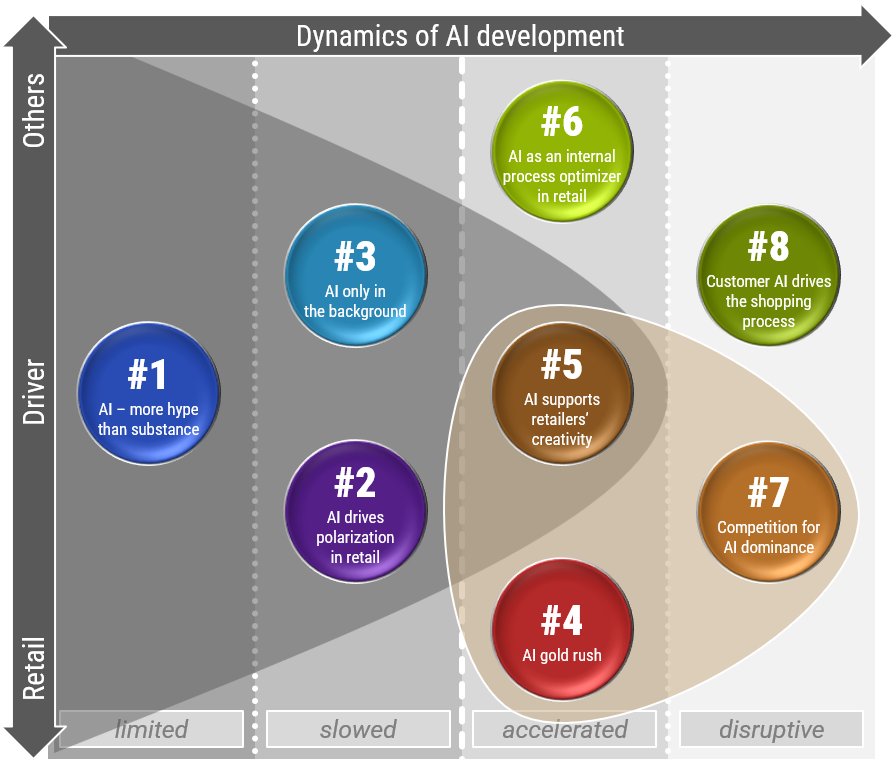
The scenarios are structured on a Map of the Future. It positions the eight future scenarios according to the dynamics of AI development – from slowed and limited to accelerated and disruptive – and according to whether retailers themselves or other actors take the leading role in shaping the use of AI. This creates development paths ranging from cautious adoption and AI-based process optimisation to entirely new, data-driven business models.
- AI – more hype than substance (Scenario 1): Economic uncertainty, low technology acceptance and restrictive approaches to data slow the development of artificial intelligence. Retail largely retains traditional business models, while AI plays only a minor role.
- AI drives polarization in retail (Scenario 2): A small number of large retailers use AI successfully and strengthen their market positions, while many smaller providers struggle to keep pace with technological change. The industry becomes increasingly divided.
- AI only in the background (Scenario 3): Artificial intelligence is used mainly to optimise internal processes, while direct customer interaction remains largely unchanged. At the same time, sustainability and regional value creation gain importance.
- AI gold rush (Scenario 4): High technology acceptance and extensive use of data accelerate the emergence of new AI-based business models. Retailers create innovative ecosystems and evolve into comprehensive solution and service providers.
- AI supports retailers’ creativity (Scenario 5): Retailers use AI selectively to create individualised offers and shopping experiences. Brick-and-mortar retail maintains its position through personalised services and the intelligent use of available customer data.
- AI as an internal process optimizer in retail (Scenario 6): High societal expectations regarding data protection and ethics restrict the use of AI in customer interactions. Instead, AI primarily improves logistics, planning and internal processes along the value chain.
- Competition for AI dominance (Scenario 7): Powerful AI systems operated by retailers, customers and technology providers compete with one another. Retail remains an active shaper of the market, but must continuously develop its own platforms and business models.
- Customer AI drives the shopping process (Scenario 8): Intelligent assistants increasingly handle shopping, product selection and purchasing decisions on behalf of consumers. Retail focuses on efficient fulfilment and develops new data-driven business models around this changing customer role.
The subsequent scenario assessment showed that the situation in 2020 was still closest to a moderate pace of AI development, while substantially stronger and increasingly disruptive use of artificial intelligence was expected over the longer term. Development paths in which retailers themselves take an active role in shaping and using AI and develop new value-creation models were considered particularly desirable. At the same time, the assessment shows that alternative pathways driven by external platforms or new forms of customer AI remain plausible.
The study helps companies identify possible developments at an early stage and test their strategies against different future scenarios. The scenarios provide a basis for systematically assessing the opportunities and risks of new AI applications, developing robust business models and testing strategic decisions for future robustness. In this way, they provide orientation for the long-term development of retail in the age of artificial intelligence.