The study builds on a long-standing collaboration between the EHI Retail Institute and ScMI AG. In a multi-stage scenario process involving 26 experts from retail companies, media, technology and service providers, alternative future visions for retail offer communication were developed. The starting point was technological, social, environmental and economic change – from digitalisation and changing patterns of media use to sustainability, resource scarcity and evolving consumption patterns. The explicit aim was not to produce a forecast, but to map out a well-founded space of possibilities for future marketing worlds.
The eight scenarios are brought together in a Map of the Future. Three core dimensions – servitisation, emotionalisation and disintermediation – structure the future space and condense it into five fundamental forms of relationships between retailers and customers: from loose transactional relationships and emotional communities of shared values to service-oriented partnerships and an increasing transfer of the customer relationship to independent platforms. This creates a systematic overview of possible development pathways for retail offer communication:
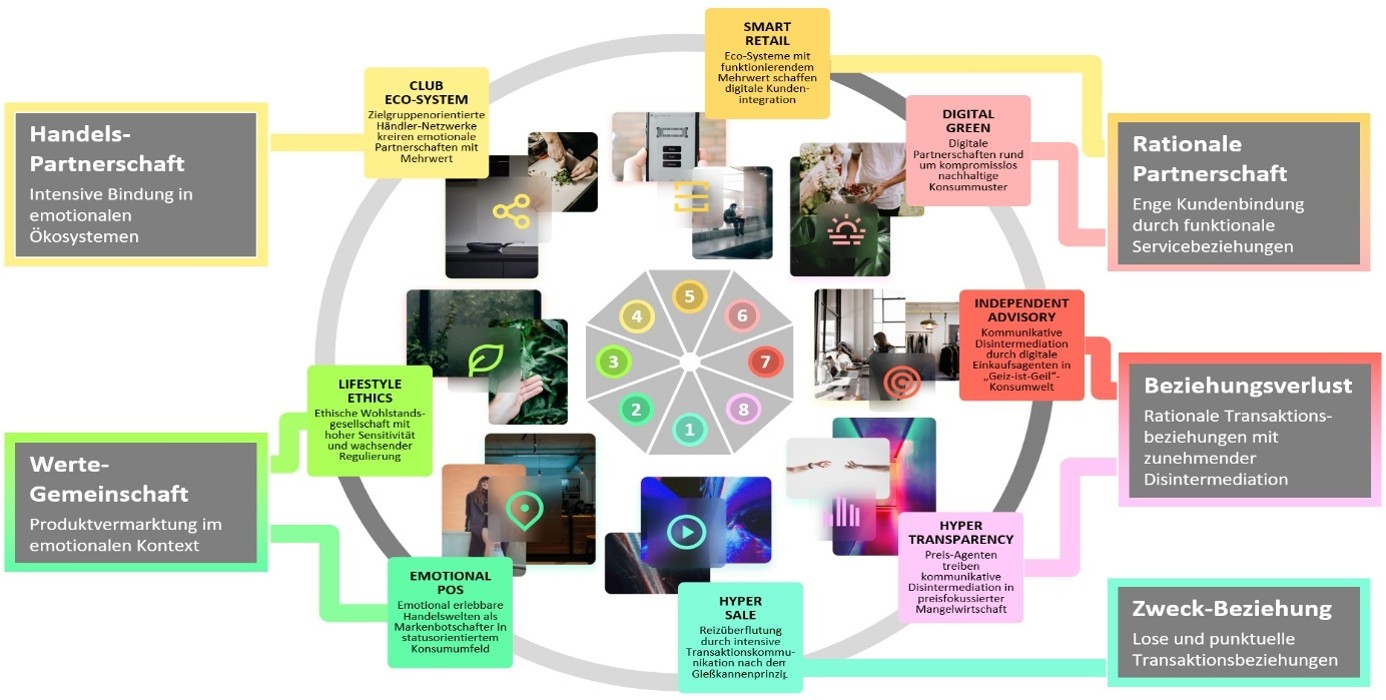
- Hyper Sale – Information Overload through Intensive One-Size-Fits-All Transactional Communication (Scenario 1): In a price-driven market, short-term sales promotion dominates, with high advertising intensity and little customer loyalty. Reach and efficiency take centre stage, while inspiration, service and emotional brand attachment lose importance.
- Emotional POS – Emotionally Engaging Retail Worlds as Brand Ambassadors in a Status-Oriented Consumer Environment (Scenario 2): Brick-and-mortar retail gains importance through emotional brand worlds, personal advice and high-quality shopping experiences. Retail offer communication focuses on storytelling, authenticity and long-term brand attachment rather than price arguments.
- Lifestyle Ethics – An Ethical Affluent Society with High Sensitivity and Growing Regulation (Scenario 3): Sustainability, social responsibility and a credible purpose shape retail communication. Companies create emotional attachment through values, transparency and responsible action.
- Club Ecosystem – Target-Group-Oriented Retailer Networks Create Emotional Partnerships with Added Value (Scenario 4): Retailers and their partners develop digital ecosystems and communities around clearly defined target groups. Emotional customer relationships and functional added value merge into long-term partnerships.
- Smart Retail – Ecosystems with Real Added Value Create Digital Customer Integration (Scenario 5): Digital services and intelligent ecosystems simplify shopping and strengthen customer loyalty. Functional added value and data-driven services become central competitive factors for retailers.
- Digital Green – Digital Partnerships for Uncompromisingly Sustainable Consumption Patterns (Scenario 6): Digitalisation and sustainability reinforce one another and shape purchasing, communication and customer relationships. Digital services support consistently sustainable consumption and make environmental transparency the norm.
- Independent Advisory – Communicative Disintermediation through Digital Shopping Agents in a “Bargain-First” Consumer World (Scenario 7): Independent digital shopping assistants take over product search, advice and purchasing decisions. Retailers’ direct influence on retail offer communication declines significantly.
- Hyper Transparency – Price Agents Drive Communicative Disintermediation in a Price-Focused Scarcity Economy (Scenario 8): Digital price agents and comparison platforms dominate customer communication in a market shaped by scarcity and price sensitivity. Competition shifts towards maximum transparency and automated price optimisation.
The scenario landscape shows that the future of retail offer communication will not be determined by a single trend. Instead, different marketing worlds emerge from the interaction of customer relationships, digitalisation, sustainability, service orientation and platform economics. The Map of the Future helps companies compare these alternatives systematically and position themselves strategically within the future space.
The study provides retailers with a frame of reference for the long-term development of their marketing and communications strategies. Rather than relying on one supposedly probable future, it enables them to consider different development pathways at an early stage, derive robust strategies and identify new opportunities for brand management, customer loyalty and retail offer communication. At the same time, it provides the foundation for the initiative’s second study, which explores possible strategy patterns for tomorrow’s marketing worlds.