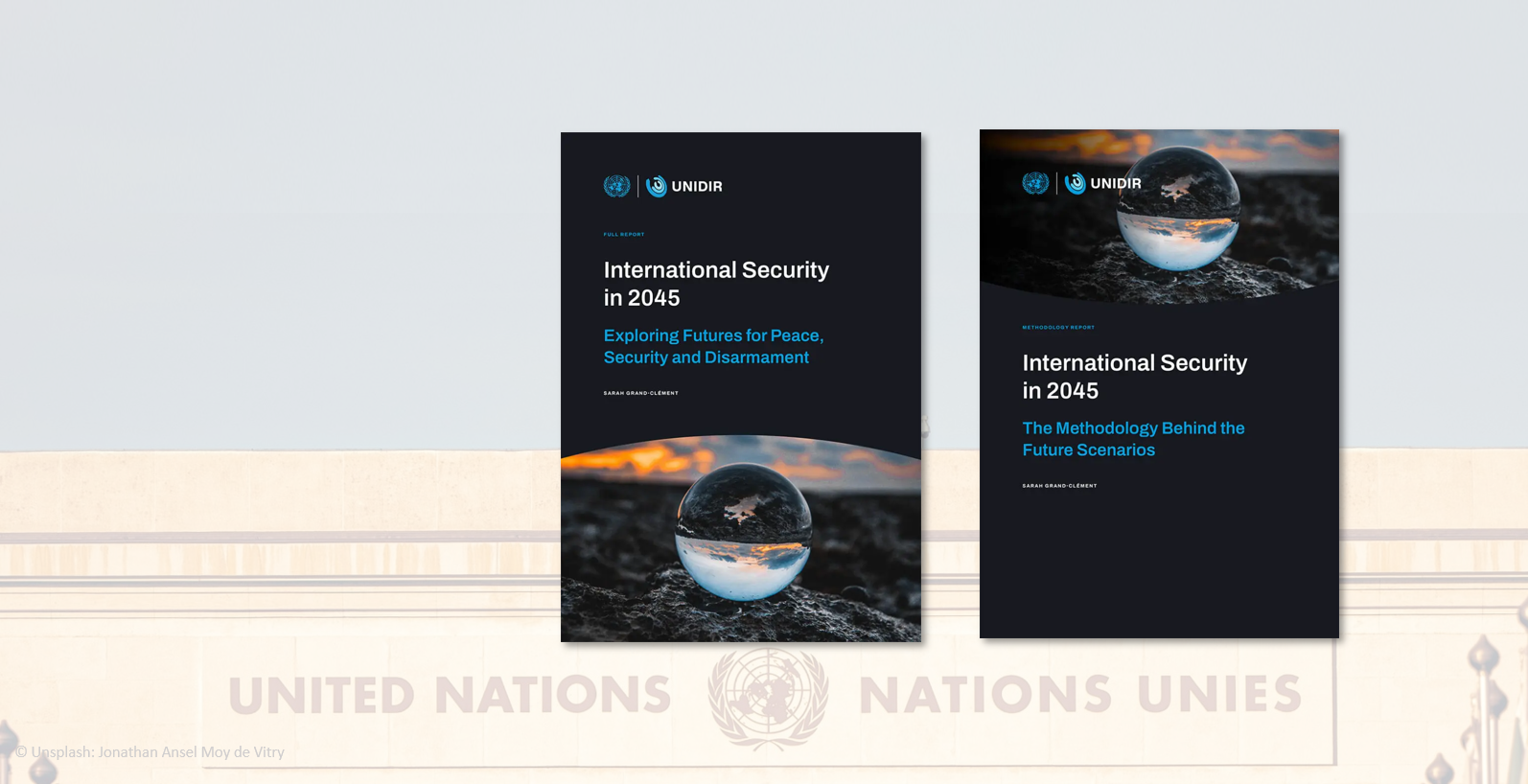
In preparation of the United Nation’s 100th anniversary, the United Nations Institute for Disarmament Research (UNIDIR) has set up a foresight process with the goal to describe potential futures for the world in 2045. Together with 22 experts, five different scenarios were created. These scenarios describe threats to international security linked to arms control and disarmament as well as offering a broader framework for the development of international relations. From these developments, challenges and possible pathways for actions for the United Nations can be derived.
Scenario 1: Waiting for Godot
Global power dynamics are shifting, with a decline in the authority of nation-states and increased tensions. The private sector plays a dominant and influential role in international relations. Conflict is prevalent but tends to be localized and falls below the threshold of armed conflict. National governance structures suffer from a rising degree of democratic backsliding. Despite challenges, the overall liveability of the planet remains intact in most places.
Scenario 2: Paradise Lost
Global power dynamics are characterized by waning interest in multilateral relations, resulting in fragmented relationships among states. The private sector’s influence in international connections is diminishing. High-intensity conflicts persist without a willingness to find resolutions. Authoritarianism dominates as the prevailing form of national governance, leading to a decrease in the overall liveability of the planet.
Scenario 3: A Modern Utopia
Global power dynamics are marked by harmonious relations between multiple spheres of influence, fostering cooperation. Private sector actors maintain their roles and influence similar to that of the early 2020s. Conflicts are infrequent and, when they occur, tend to be localized. Democratization is the prevailing form of national governance, contributing to increased liveability on more parts of the Earth compared to the early 2020s.
Scenario 4: War and peace
Global power dynamics are polarized, creating a fragmented world between two dominant poles of power. Private sector actors experience decreased influence in international relations. Conflicts are frequent but primarily localized and low-intensity. There is a notable tendency towards democratic backsliding in the majority of national governance structures, contributing to a decrease in the overall liveability of the planet.
Scenario 5: Fragmented Fault Lines
Global power dynamics are characterized by fragmentation among multiple spheres of influence worldwide. Private sector actors play an important and influential role in international relations. Conflicts are relatively few and typically fall below the threshold of armed conflict. Democratization is prevalent as the majority form of national governance, contributing to the overall liveability of most places on Earth.
The scenarios were developed with the help of ScMI’s software Scenario-ManagerTM. On the basis of these scenarios, a number of potential threats to international security were derived during workshop sessions with a variety of participants. The scenarios thus served as a vehicle which allowed participants to project themselves into different futures with their own set of potential developments and corresponding issues. Threats focused on a number of different actors, such as the UN and its member states, and their actions as well as general themes and trends such as technology and innovation.
Based on the identified threats, a set of issue-specific pathways for action were developed during workshop sessions as well as by conducting expert interviews. These pathways showed a high variety in implications considering both their scope as well as time frames. The aspects discussed can be employed as a basis for more in-depth discussions of the future role of the United Nations in international security.
The full report as well as the methodology report are available for download.