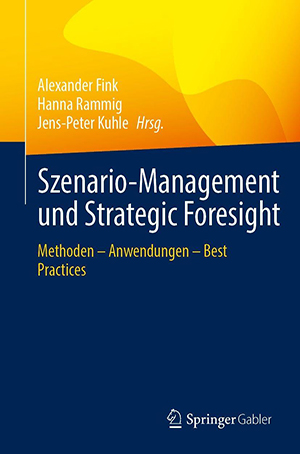
Our new book, “Szenario-Management und Strategic Foresight – Methoden, Anwendungen, Best Practices”, will be published by Springer Gabler in November. It brings together more than 30 years of experience in working with scenarios and combines this expertise with current approaches and perspectives from the international foresight community.
The world has not necessarily become more uncertain – but many developments are unfolding faster, becoming more interconnected and following less linear paths. Geopolitical shifts, technological breakthroughs, climate change, social polarization and, not least, artificial intelligence are reshaping the conditions under which strategic decisions are made. For companies and organizations, it is becoming increasingly difficult to think about the future simply as an extrapolation of the present.
This is precisely where scenarios and Strategic Foresight come into play. Their purpose is not to predict the future. Instead, they help us explore different possible futures, understand relationships and consequences, and use these insights to make better decisions today. As Florence Gaub highlights in her foreword to our book, there is no single future, but a range of possible futures – and scenarios make these futures imaginable and, as a result, more open to being shaped.
From 30 years of Scenario Management to a new book
The idea for the book emerged in summer 2023, when we celebrated 30 years of Scenario Management and 25 years of ScMI in Paderborn. In conversations with many friends, clients and partners, it became clear just how broad the field has become. Scenarios are now used across a wide range of industries, support strategy, innovation and transformation processes, and have long since become an important element of Strategic Foresight.
This sparked the idea of bringing together the knowledge accumulated over many years and projects in a new way: to further develop our own methodological approaches, systematically capture lessons from practical experience, and connect them with other approaches and perspectives from the international foresight community.
The result is “Szenario-Management und Strategic Foresight – Methoden, Anwendungen, Best Practices”, which will be published by Springer Gabler in November 2026. The book is in German – however, eight of the 34 contributions are articles in English.
Three perspectives on working with the future
The book is organized around three main areas: methods, applications and best practices. It deliberately does not set out to promote one single “right” way of approaching the future. Instead, it brings together different schools of thought, methodologies and practical experiences.
The section on methods further develops Scenario Management and Future Management and connects them with international foresight concepts. These include Andy Hines’ Six Step Model, Mats Lindgren’s TAIDA framework, the foresight approach used by the UK Ministry of Defence, as well as a range of other international perspectives.
The second section focuses on applications: How can scenarios be linked to strategy development? How can they support innovation and transformation? What role can they play in societal and political discourse? And how are digitalization and artificial intelligence changing the way we work with the future?
A strong practical perspective was equally important to us. Numerous contributions illustrate, through concrete projects, how Scenario Management and Strategic Foresight are applied in companies, public institutions, regions and wider societal futures processes. Examples range from Bosch and TÜV Rheinland to the EHI Retail Institute, regional economic development organizations and the societal futures initiative “D2030 – Deutschland neu denken”.
A book created by the community
This makes the book much more than a new ScMI methodology book. It is a collaborative effort. Alongside colleagues from ScMI, numerous practitioners and internationally recognized foresight experts have contributed their experience and perspectives. The forewords were written by Florence Gaub and long-standing UNESCO foresight expert Riel Miller.
This diversity was important to us because the practice of working with the future itself is evolving. New methodological approaches are emerging, foresight is becoming more closely connected with strategy and transformation, and artificial intelligence is opening entirely new possibilities.
The book therefore also explores AI-supported scenario work. Fittingly, it concludes with scenarios on the future of futures research in Germany – developed with the involvement of synthetic AI experts.
Don’t stop thinking about tomorrow
Perhaps the idea behind the book is best captured by a small detail from its origin story. The soundtrack to our anniversary celebration in 2023 was “Don’t Stop Thinking About Tomorrow”. Three years later, we are publishing a book that is intended to do exactly that: encourage people to think about tomorrow – openly, systematically and from different perspectives.
Because the future never stops unfolding. It continually opens new directions and possibilities. Scenarios can help us recognize possible futures earlier, understand them more clearly and shape our own future more consciously.
“Szenario-Management und Strategic Foresight – Methoden, Anwendungen, Best Practices” will be published by Springer Gabler in October 2026 and is available to order from, among others:
Methods, Applications, Best Practices