2021 was also the year of Germany’s federal election. For the first time in post-war history, the incumbent chancellor – in this case, Angela Merkel – did not stand again, and voters were particularly uncertain about whom to support. The “Wahl-O-Mat”, Germany’s best-known online voting advice tool, once again offered guidance. It also prompted ScMI to bring out its own tools and design a “political map” – another way of creating orientation.
The Wahl-O-Mat is the best-known, though not the only, online voting advice application in Germany. Since 2002, the Federal Agency for Civic Education (bpb) has used it to bring transparency to the increasingly crowded landscape of political parties and election manifestos. It was used more than 15 million times for the 2017 federal election – and that figure was exceeded again in 2021.
As interesting and helpful as results presented in lists and percentages may be, they can still leave users somewhat at a loss. Inevitably, people wonder where they themselves stand, but also how the different parties – especially those recommended to them – relate to one another. Without an overview, the results invite tactical calculations rather than strategic interpretation. This question led us to a small experiment:
Imagine for a moment that Germany were a company looking for a new strategy for the future – after all, this is the field we work in every day. Would there not be 40 different strategic concepts on the table, in the form of the election manifestos of the parties standing in the federal election? This reminds us of a situation we often encounter – and deliberately create – in strategy processes. Together with executives, we develop a range of conceivable strategies, which we call strategic options or strategy scenarios. These are visualised on a strategy map that reveals similarities and differences. So why not develop a political map of Germany?
Our analysis was based on the 38 questions used by the Wahl-O-Mat. In methodological terms, these are the strategy elements, each with three possible options: agree, disagree or neutral. The parties’ combinations of answers allow their manifestos to be compared and represented graphically using multidimensional scaling.
The map shown in our graphic provides an overview in which parties with similar election manifestos are placed close together, while those with very different programmes are positioned far apart. In this way, a multidimensional system is arranged in two-dimensional space with as little loss of information as possible. At this stage, the axes have no substantive meaning, so the entire graphic can still be rotated freely – for example, so that traditionally “left-wing” or progressive parties appear on the left and traditionally “right-wing” or conservative parties on the right. But this already constitutes an initial interpretation of the political map and can of course be debated at length, especially since the conventional left-right spectrum has itself been under discussion for many years.
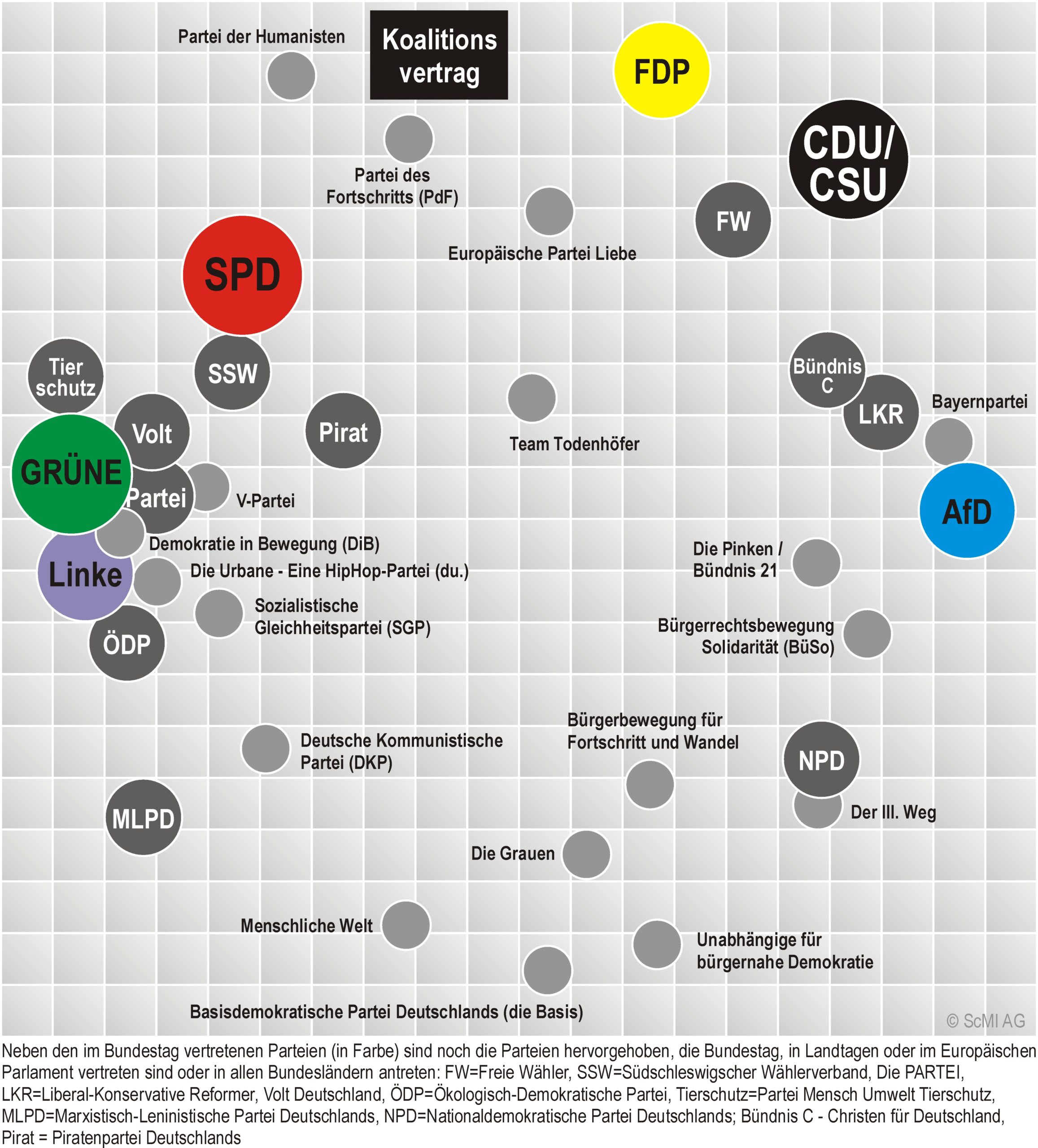
The arrangement also appears relevant to the central issue of climate change. When the relevant questions are analysed, parties on the left-hand side of the map advocate particularly stringent climate-protection policies, whereas the positions of groups on the right-hand side tend to be more moderate.
The obvious next question is which issues and questions lie orthogonal to the left-right or progressive-conservative spectrum. An initial interpretation suggests that the upper part of the map contains the so-called established parties – especially the SPD, FDP and CDU/CSU – whereas the lower part is more likely to contain populist groupings that are explicitly critical of the political system and political establishment. Looking more closely at the differences, two perspectives can be distinguished: an economic or economic-policy perspective, and a cultural or socio-political perspective:
The upper-right area contains traditional centre-right positions, generally associated with a strong focus on business and economic growth. By contrast, classic socialist positions are particularly pronounced in the lower-left corner. The cultural or socio-political perspective runs almost orthogonally to this economic perspective. The upper-left area contains positions that can be summarised as an open, globally oriented view of Germany. On the other side are more traditional positions, extending as far as classical nationalism.
While the political map shows the platforms of all parties and groupings with a dedicated election manifesto, a more in-depth analysis can also zoom in on the space occupied by the main political actors—in particular, the six parties represented in the Bundestag.
We carried out an additional analysis in December 2021, when the coalition agreement of the new governing alliance between the SPD, the Greens and the FDP was available. We included the coalition agreement in the analysis as a “39th party manifesto.”
As noted above, the political map was a spontaneous experiment in which we drew on our experience in developing future scenarios and strategies. Our internal discussions already showed, however, that this kind of visualisation can make relationships easier to recognise – or, as Peter Drucker put it: “To make knowledge productive, we will have to learn to see both forest and tree. We will have to learn to connect.”