Few industries have featured as prominently in foresight studies in recent years as the automotive industry and mobility more broadly. This is hardly surprising: in few other fields are today’s megatrends and technological developments exerting such powerful forces and opening up so much scope for disruptive change. Scenarios help us understand the forces shaping the mobility transformation path.
Urbanisation, artificial intelligence, climate change, resource scarcity, flexible and mobile work, and many other trends are very likely to change both how much we travel and how we move. At the same time, the future of mobility is almost an existential question for Germany as an industrial location. Estimates suggest that one in seven jobs in Germany depends directly or indirectly on the automotive industry. ScMI AG has therefore examined the topic in depth. Alongside numerous client projects with BMW, Bosch, Continental and Volkswagen, we have explored the future of urban and rural mobility from a wide range of perspectives in multi-client projects and presented the results at numerous conferences. In this article, we take a broader look at the insights and patterns that emerge from comparing these different projects.
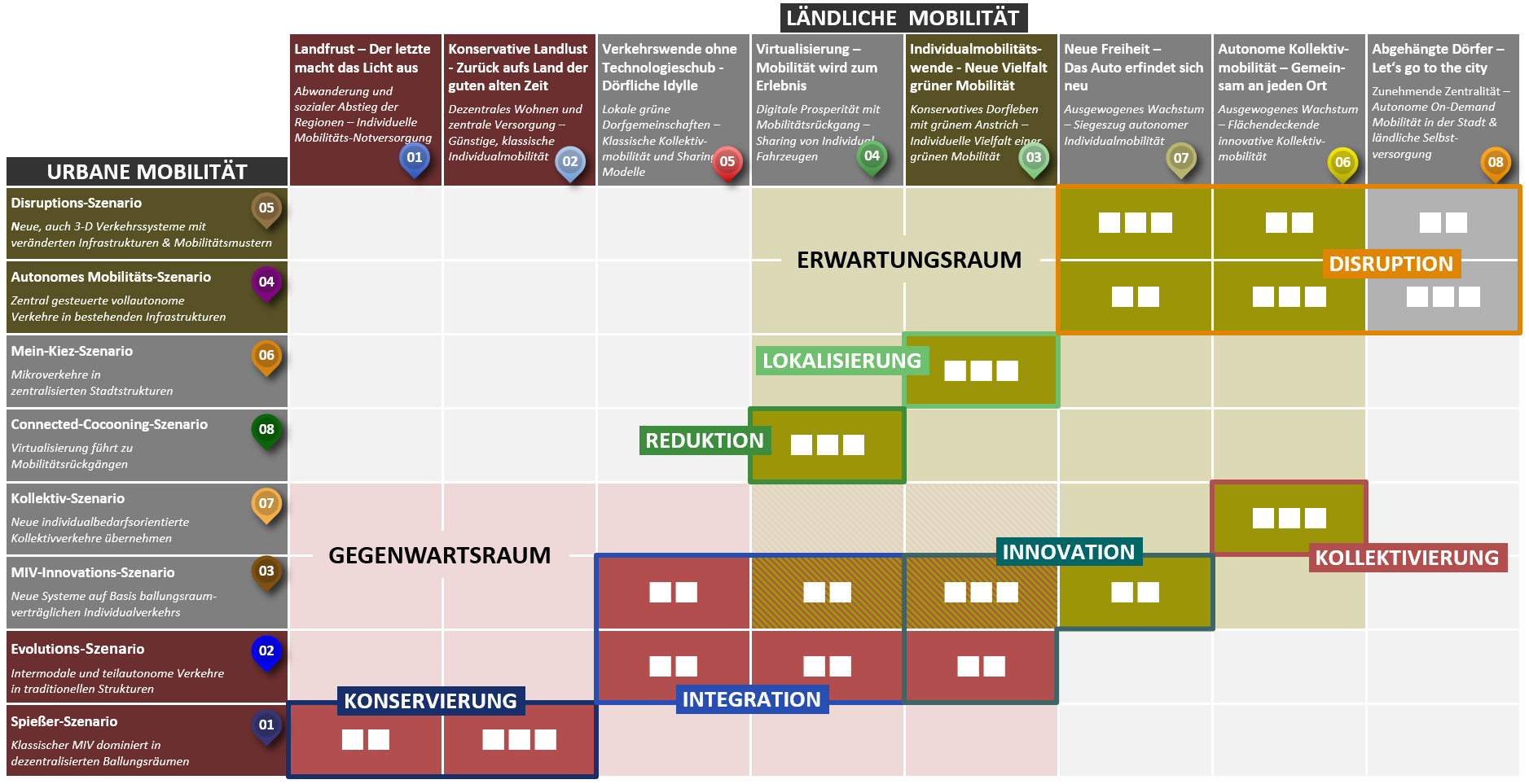
Our starting point is the linkage of our publicly available studies on rural and urban mobility. Insights from many other client projects can be viewed through this lens. To do so, we compared the scenarios from the multi-client processes and combined them into holistic mobility worlds (see graphic).
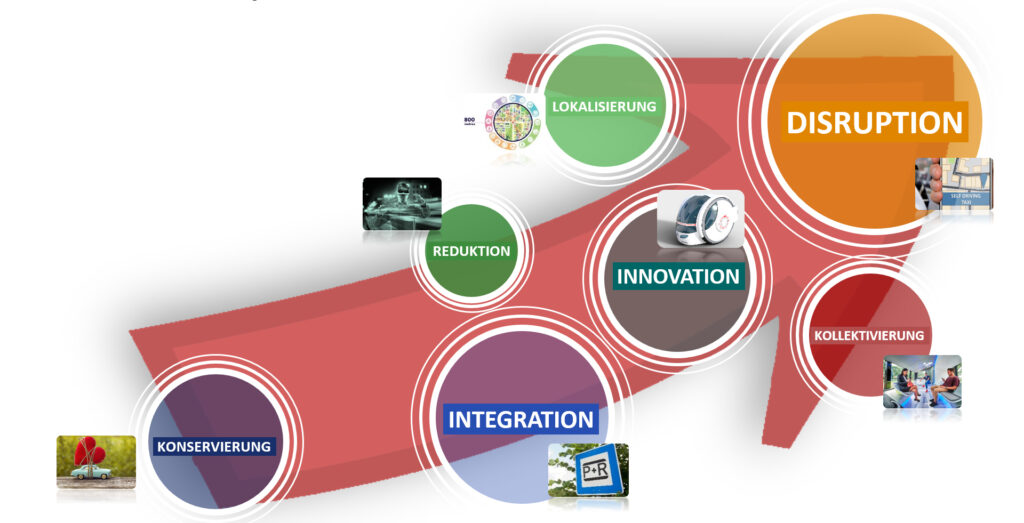
This overarching perspective reveals several recurring patterns or paradigms that repeatedly appear in discussions about the future of mobility. The same paradigms can also be found across a wide range of client projects. There, however, they are usually placed in a more specific context and supplemented with statements on strategically relevant details such as drive systems or vehicle interiors. Before turning to these individual aspects, we first look at the underlying patterns:
Preservation: The first paradigm can be understood as “status-quo thinking”. It assumes that no fundamental change will ultimately take place. People will continue to value individual mobility and private vehicle ownership. Restrictions on mobility and consumption remain difficult to imagine.
Innovation: Particularly in urban areas, the transition to the second pattern is fluid. Here, the mobility system continues to evolve, often through powerful innovations that preserve the existing system. Fully autonomous vehicles remain a dream, while technological change is driven primarily by sustainable propulsion systems or the desire for faster travel. From a critical perspective, this could also be described as the “greenwashing” of today’s mobility behaviour.
Integration: Another vision rooted strongly in an urban understanding of mobility is “intermodal mobility”. It describes a future in which autonomous small vehicles and shuttles are closely integrated with high-capacity public transport. While conventional private transport generally continues to dominate in rural areas, urban centres become increasingly connected through networked mobility systems and services. This vision requires the automotive industry to rethink its role fundamentally – moving towards service platforms, alternatives to private cars and collective mobility systems.
Localisation: Another pattern follows the widely discussed concept of the “15-minute city”, in which all relevant destinations can be reached quickly and over short distances from every household. A similar idea appears in rural areas in the form of more self-sufficient villages and is strongly driven by sustainability ambitions. Mobility remains predominantly individual, but increasingly relies on micromobility, sharing and green technologies. Change therefore comes more from urban development and spatial planning, creating greater diversity in mobility options.
Reduction: The paradigm of “immobility” or a “decline in mobility” was already visible in discussions ten years ago, but was often dismissed as irrelevant. Only the COVID-19 pandemic created broader acceptance of a future in which mobility becomes less important overall or shifts strongly towards leisure. Conceptually, this vision includes the localisation pattern described above and extends it through efforts to avoid commuting and everyday service-related journeys wherever possible. The idea is often associated with radical sustainability through restraint, although it can also go hand in hand with greater leisure consumption.
Collective Mobility: Alongside greener forms of individual mobility, stronger collective transport is often promoted as an alternative route to sustainability. One version of this future assumes that existing systems will primarily be strengthened through public investment. Technological change remains limited, while public transport is expanded in its current form and, in some cases, made cheaper – developments that partly echo the debate around Germany’s €49 ticket.
Disruption: The final pattern is shaped primarily by a breakthrough in autonomous driving. The assumption is that this technology triggers a mobility boom based on individually used vehicles that are widely shared rather than privately owned – a form of servitisation. It is therefore the counter-model to “immobility” and a strong driver of decentralisation. This vision contains several interesting variants. Some place greater emphasis on autonomous collective mobility and shuttle services. Others ask whether autonomous mobility will develop differently in cities and rural areas. Some experts, for example, consider limited use of the technology in urban settings plausible while rural areas become increasingly disconnected.
It is interesting to combine the expert assessments from the two scenario processes on urban and rural mobility. The result shows that the present is shaped primarily by the preservation paradigm, supplemented by developments from the integration and innovation patterns (see the red area in the graphic).
A comparison of expectations for urban and rural mobility is particularly revealing. The highest-rated future visions in each field – the disruption and autonomous-mobility scenario in urban areas and the “Individual Mobility Transition” scenario in rural areas – are not consistent with one another when considered together. This points to a structural difference between mobility development in urban and rural regions. At the same time, six of the seven patterns lie within the broader expectation space (yellow area in the graphic); only preservation is almost entirely ruled out in both fields.
The patterns presented here outline the broad storyline of many mobility discussions in our projects. They do not replace a detailed examination of a company’s specific environment; rather, they can enrich it. With this in mind, we would like to look at concrete examples from the past financial year.
In a current project with Continental, we developed future visions for passenger and freight mobility. The resulting scenarios reflect all of the paradigms described above. This raises the question of what added value such analyses provide. The answer becomes clearer on closer inspection of the results. First, the futures that are particularly relevant to the client’s strategic focus were differentiated in greater detail. This generated many additional perspectives on individual-mobility patterns and led to new sub-scenarios within “continuity.” The “immobility” pattern was also placed in a new context by considering an energy crisis or excessive government regulation. Other paradigms, by contrast, merge in broader analyses. At the same time, the scenario content is more closely aligned with Continental’s business. Many aspects that are directly related to the company’s core strategic questions are examined in greater detail within the future visions.
Overall, the analysis shows that the mobility scenarios presented here cannot replace a tailored foresight process; their primary role is to enrich and strengthen it. One important aspect should not be overlooked: engaging directly with the topic and going through the process itself are essential for increasing acceptance and understanding of the result. “Off-the-shelf scenarios” can therefore stand in the way of seriously deriving strategic consequences.