In her book “Mission Economy: A Moonshot Guide to Changing Capitalism”, Mariana Mazzucato asks what would happen if the same innovative power that took humanity to the Moon 50 years ago were applied to the challenges of the present. Following this idea, mission-oriented approaches have become a central theme in many current policy debates. Time for a few thoughts and propositions.
As a direct consequence of the Sputnik shock, U.S. President John F. Kennedy announced in May 1961 that the United States should commit itself to landing a person on the Moon and returning them safely to Earth before the end of the decade. In a speech at Rice University in the autumn of 1962 – more than 60 years ago – he reinforced the goal of the lunar mission: “We choose to go to the Moon in this decade and do the other things, not because they are easy, but because they are hard.”
The sentences that followed are particularly interesting, although they are less widely remembered: “because that goal will serve to organize and measure the best of our energies and skills, because that challenge is one that we are willing to accept, one we are unwilling to postpone, and one which we intend to win.”
These closing lines in particular make clear why the Apollo program still inspires many strategic and leadership approaches that remain relevant today. But what can genuinely be transferred from it? Can a successful mission from 60 years ago show us how to meet today’s challenges?
Thesis 1: When It Comes to Goals, Aim Higher
In March 1961, NASA Administrator James E. Webb submitted a budget request to finance a Moon landing before 1970, which President Kennedy rejected as too expensive. A few weeks later, Yuri Gagarin’s first human spaceflight changed Kennedy’s assessment of the situation. He sensed the humiliation and fear felt by the American public over the Soviet lead and announced the goal of a crewed lunar mission in May 1961. It remained expensive, bold and perhaps even reckless. It was also unpopular: according to a Gallup poll, 58% of Americans thought a Moon landing was a bad idea. It would probably have been easier to say something less audacious, such as, “We will expand our space program.” But Kennedy did not do that. He chose a big goal—a bold mission.
In the 1990s, James C. Collins and Jerry I. Porras studied the most enduring and successful companies and examined why they were better able than their competitors to meet changing challenges over the decades. Their conclusion was that successful companies particularly often pursue bold missions—so-called BHAGs, or “Big Hairy Audacious Goals.” These are not difficult-to-understand target systems or detailed task descriptions, but challenging and inspiring visions of the future and the goals to be achieved.
Collins and Porras also argue that highly visionary companies do not submit to the “tyranny of the OR” but instead harness the “genius of the AND.” A strategic mission beyond a purely profit-oriented purpose can therefore coexist with pragmatic profit seeking. Likewise, a clear vision and direction do not conflict with seizing unexpected opportunities or with a willingness to experiment.
Thesis 2: Strategy – the Bad, the Good and the Robust
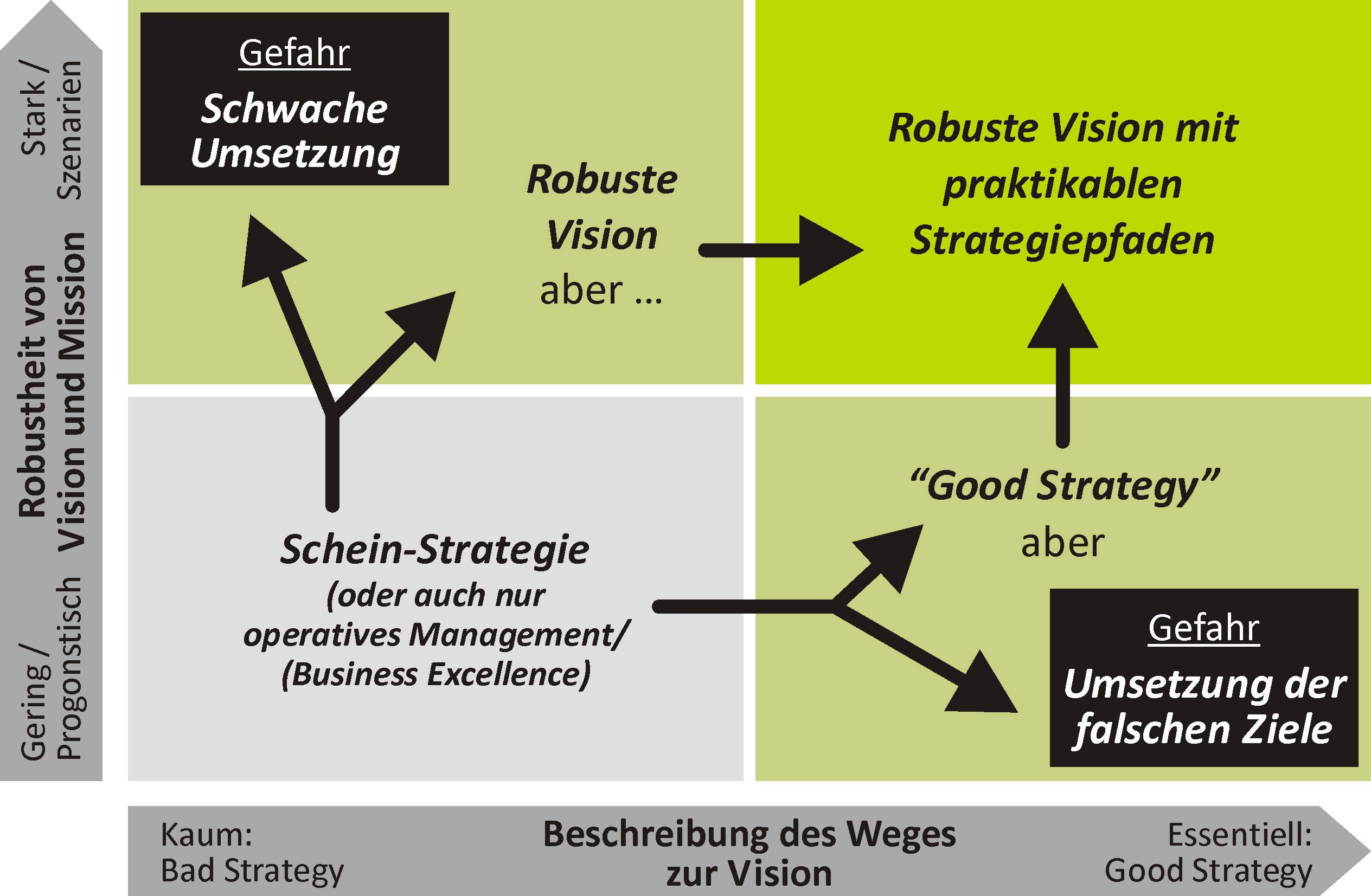
There are many definitions of strategy. One simple—and fitting—definition is that a strategy describes a path toward a vision. This is often where the debate begins, because some regard the vision as part of the strategy, while others do not. One way to avoid this rather theoretical discussion is to reverse the perspective and recognize that a vision alone is not yet a strategy. A vision or goal can provide a good starting point for a strategy. The strategy itself, however, must outline how the vision and the associated goals are actually to be achieved.
In his book “Good Strategy/Bad Strategy,” Richard Rumelt illustrates this distinction clearly. A bad strategy may describe what a company should look like in the future, but it leaves the path for getting there unclear. Beyond confusing goals with strategy, it can be recognized by three other characteristics: (1) an inability to face the real challenges, (2) inappropriate or unworkable strategic objectives, and (3) abstruse jargon—in other words, a kind of bullshit bingo.
What, then, makes a good strategy—apart from the fact that it points to a path into the future beyond a visionary goal? According to Rumelt, strategy is above all about focus and therefore prioritisation. Some goals are set aside in favor of others. This is at the heart of strategy, which is often most compelling when it clearly states what an organisation does not intend to do. It can become problematic, however, when that focus shifts from priorities the organisation can shape itself to external conditions it cannot control.
As complexity and uncertainty increase, neither companies nor public institutions can plan on the basis of unambiguous forecasts and reliable boundary conditions. Instead, they need to develop alternative scenarios and incorporate them into decision-making. Depending on how uncertainty is assessed, this may mean focusing on individual scenarios or addressing several scenarios through a robust approach. Robust approaches range from safeguarding strategies—for example through insurance—to complementary or dual strategies and genuinely integrative approaches.
Thesis 3: The Greater the Need for Transformation, the More Important Mission-Oriented Thinking Becomes
Heraclitus already knew that nothing is as constant as change. Nevertheless, societies, states and companies go through phases of particularly intense, fundamental and often abrupt change, which we describe as transformation. Such transformations can be triggered by new technological and economic possibilities (digitalisation), significant changes in the external environment (climate change) or substantially altered social needs.
The Stockholm Environment Institute and the German Advisory Council on Global Change (WBGU) have each called for a “Great Transformation”. The WBGU argues that production, consumption patterns and lifestyles need to change across three transformation fields: energy, urbanisation and land use. It is not yet possible to assess whether today’s multiple crises, Germany’s “Zeitenwende” (watershed moment) or the “New Era” will give rise to additional fields of transformation.
Every transformation can be understood as a long-term process of learning and exploration that lasts for several decades and involves considerable uncertainty. A transformation is only complete once new system structures have become permanently established and stabilised. During the preceding periods of upheaval, solving individual current system problems is not enough, because doing so almost inevitably creates new problem areas in the future and thereby erodes confidence in political decision-making capacity.
For this reason, the concept of a “mission” has been widely taken up in the public and political sphere in recent years. In Mariana Mazzucato’s formulation, a mission-oriented approach means setting goals for the economy and then placing the problems that must be solved to achieve those goals at the centre of redesigning the economic system. She understands this as designing public policies that, by involving companies and citizens across a broad spectrum of economic actors, catalyse investment, innovation and collaboration.
Scenarios can provide a conceptual framework for formulating such missions. In an open scenario process, the D2030 initiative developed a range of future visions for “Germany 2030” and assessed them through a dialogue process. A key characteristic of the scenarios is that they connect a total of 33 key factors from different areas of the system, including the economy, politics, education, work, innovation, the environment and security. The scenario assessment also showed that the so-called “New Horizons” scenarios outline a shared preferred-future space that can serve as a basis for societal missions.
Thesis 4: In a Complex World, It Is About a “Future for All”
Missions may be initiated or designed by visionaries, but they can hardly be implemented single-handedly any more. This applies in companies, where increasingly collaborative ecosystems need to be shaped, as well as in public-policy fields characterised by even greater complexity. The German Commission of Experts for Research and Innovation (EFI) therefore speaks of a “new mission-oriented R&I policy” and distinguishes it from the classical form exemplified by the U.S. Moon mission.
Classical missions were designed to advance a major technological undertaking through innovation – usually under centralised leadership, as with NASA. Today’s missions, by contrast, are far more complex. Global climate protection, the energy transition, and European technological or data sovereignty can only be achieved by combining technological innovation with political action and changes in social behaviour. Such missions also cut across many policy fields at the same time. New mission-oriented R&I policy therefore requires close cooperation among different ministries, the involvement of expert groups and, above all, broad public dialogue with citizens.
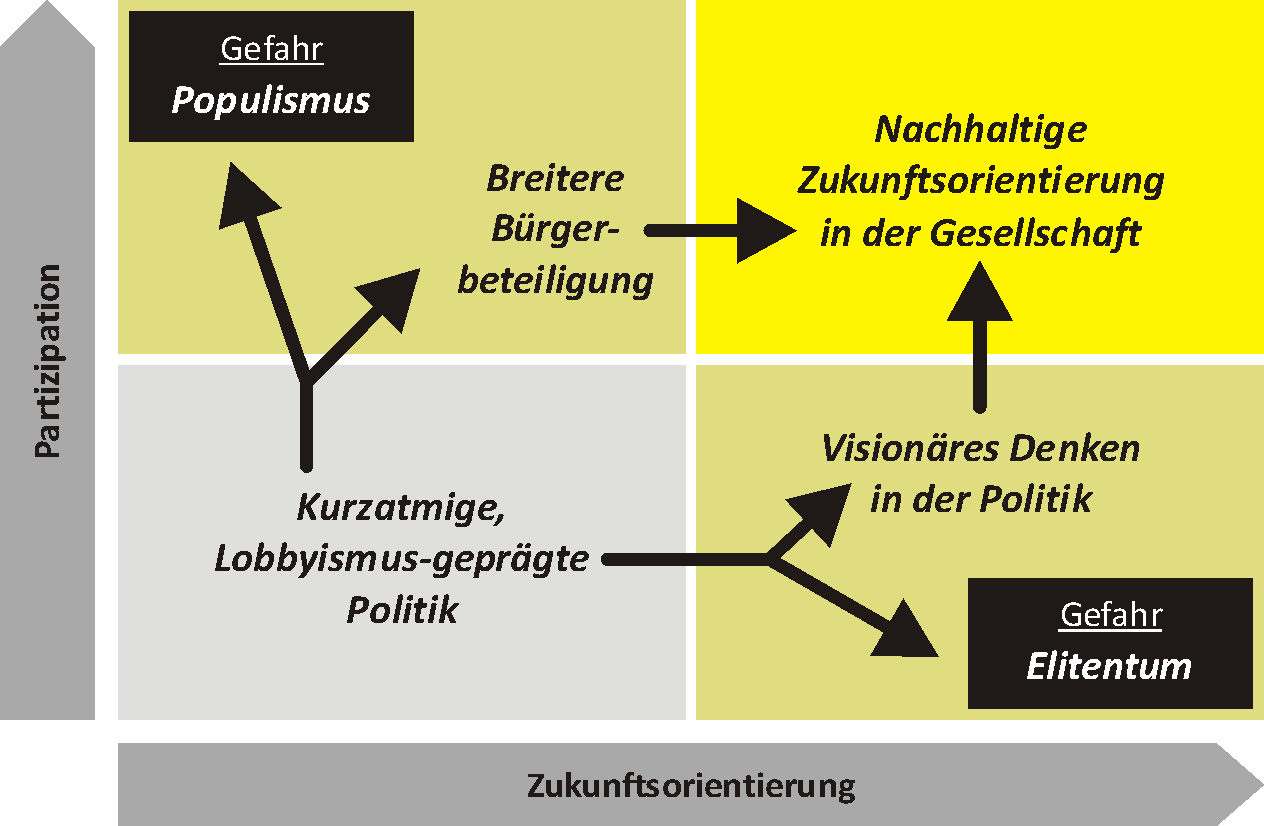
Reflecting on its scenario process, the D2030 initiative reaches a similar conclusion and describes the guiding principle “Zukunft für alle” (“Future for All”), which combines future- and mission-oriented thinking with civil-society participation. A purely expert-driven focus on the future can risk becoming elitist, while participation that loses sight of future challenges can provide fertile ground for populism. The challenge, therefore, is both to make foresight and mission processes broadly inclusive and to orient participatory processes towards future challenges.
See also: https://medium.com/@alexander-fink/missionen-der-mond-und-wir-alle-7a120305d59f