
The debate surrounding the rise of right-wing populist parties is often framed in very fundamental terms. Some see every political shift as another step towards the inevitable authoritarian transformation of Western democracies. Others regard participation in government simply as a normal democratic transfer of power. Yet both perspectives often fall short.
In the scenario project Old Divides, New Dangers by D2030 – Deutschland neu denken e.V., we therefore took a different approach, systematically exploring the role that right-wing populism could play in the years ahead. To do so, we applied the Scenario Management methodology.
The scenarios are described in a freely available study report as well as in Sally Lisa Starken’s recent book Wenn der rechte Rand regiert (When the Political Right Governs). The following graphic provides a compact overview of the eight possible scenarios, which can be grouped into four categories:
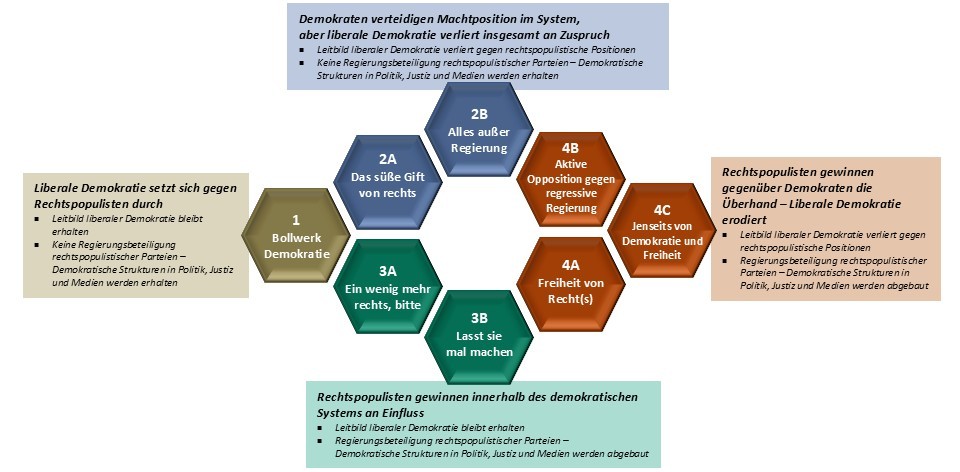
- Bulwark of Democracy (ochre): In this basic scenario 1, liberal democracy is successfully strengthened. Political parties, institutions and civil society act in a coordinated manner and with a clear awareness of democratic values. The political centre remains capable of taking action, while populist positions are contained through political debate and institutional mechanisms.
- Creeping Adaptation (blue): Basic scenario 2 describes the adaptive path, in which the institutional exclusion of right-wing populists from government – referred to in Germany as the Brandmauer, or “firewall” – continues. This may lead to the adoption of right-wing populist issues (2A), combined with restrictions on the scope for action available to democratic forces (2B).
- Right-wing Populists in Government (green): Basic scenario 3 describes an institutional path in which right-wing populists gain influence within the democratic system. They become directly involved in government, either at municipal or state level or as junior partners (3A), or by taking a leading role in government themselves (3B). The liberal framework remains in place, but the judiciary, media freedom and minority rights come under increasing pressure.
- Authoritarian Transformation (red): In basic scenario 4, far-right or nationalist forces control state institutions, restrict fundamental rights and hollow out liberal democracy. This may occur through libertarian promises of freedom (4A), in the face of resistance from civil society (4B), or within largely authoritarian structures (4C).
These scenarios are explicitly not forecasts. They are tools for understanding and interpreting different ways in which right-wing populism could develop in the future. The study therefore also identifies tipping points that may mark transitions from one scenario to another, as well as measures that could support a return to democratic scenarios.
Old Divides, New Dangers as a Frame of Reference – AI-Supported Assessment of Six Countries
Within the original study, the scenarios were deliberately developed as tools for thinking and were not assessed. In a second step, we have now carried out an initial AI-supported assessment, primarily to explore two questions in greater detail:
Where does Germany stand today – and what impact could the upcoming state elections, particularly in Saxony-Anhalt, have?
How can developments in selected countries be understood through the lens of these scenarios – and what can we learn from them in Germany about dealing with right-wing populism?
We therefore examined six countries that represent different approaches to right-wing populism: Germany, the United States, Italy, the Netherlands, Poland and Hungary.
Methodologically, the individual key factors contained within the scenarios and their associated future projections were assessed for each country. These detailed results were then used to derive an overall assessment for each of the eight scenarios.
Political debate still dominates – but what happens in the autumn?
Germany is the starting point for our analysis. According to the AI-supported assessment, Germany currently lies primarily between scenario 1, “Bulwark of Democracy”, and scenario 2A, “The Sweet Poison from the Right”. Right-wing populist positions currently influence numerous political debates, including those concerning migration, internal security and national identity. At the same time, democratic institutions remain stable, and the AfD has so far participated neither in a state government nor in the federal government.
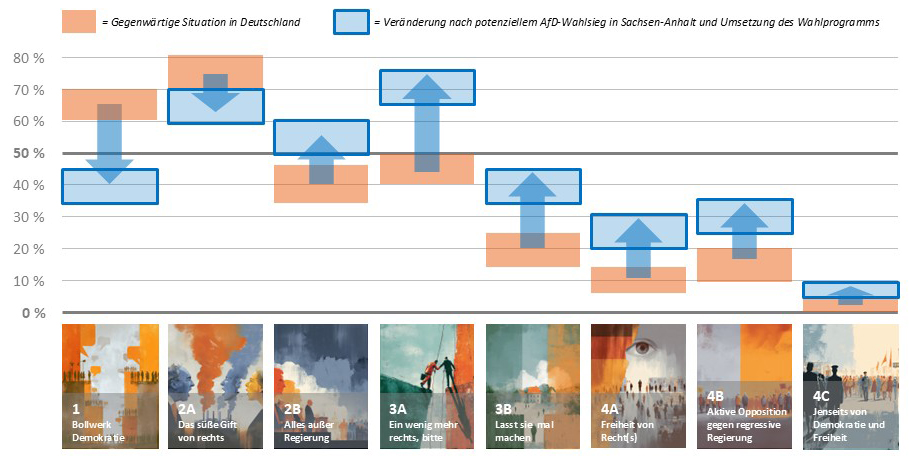
Against this background, a second assessment examined the hypothetical case in which the AfD wins an absolute majority in Saxony-Anhalt and is able to implement large parts of its election programme. Under this assumption, the assessment shows a significant shift within our scenario space: a move away from the previously dominant adaptive path towards the institutional path, and particularly towards scenario 3A, “A Little More to the Right, Please”. Overall, the previously dominant scenarios 1 and 2A lose explanatory power, while all other scenarios gain in importance.
Equally noteworthy, however, is what does not happen. Our analysis does not place Saxony-Anhalt immediately within the authoritarian structures described by the group 4 scenarios. Instead, it initially shows the changes that can arise simply through a democratically legitimised change of government. A key question therefore is how democracies change when right-wing populist parties assume lasting responsibility for government for the first time. This is precisely where the international comparison cases provide insight.
The United States and Italy: Government responsibility does not automatically mean a shift towards totalitarian structures
The United States and Italy show that right-wing populist participation in government can lead to very different developments. In both countries, the phase of adopting issues from the political right or politically distancing established parties from right-wing populists has long since been surpassed. Both Donald Trump and Giorgia Meloni lead governments shaped by right-wing populism. Both countries therefore lie clearly within scenario 3B, “Let them have a go”.
However, a look at the entire scenario space reveals substantial differences despite these similarities. In the United States, numerous characteristics now indicate increasing pressure on democratic institutions. Conflicts involving independent agencies, courts, the media and universities, together with increasing polarisation, mean that the United States is already moving strongly towards the authoritarian transformation described in the group 4 scenarios. This applies particularly to scenario 4B, “Active opposition to a regressive government”, which also includes active political and civil-society opposition.
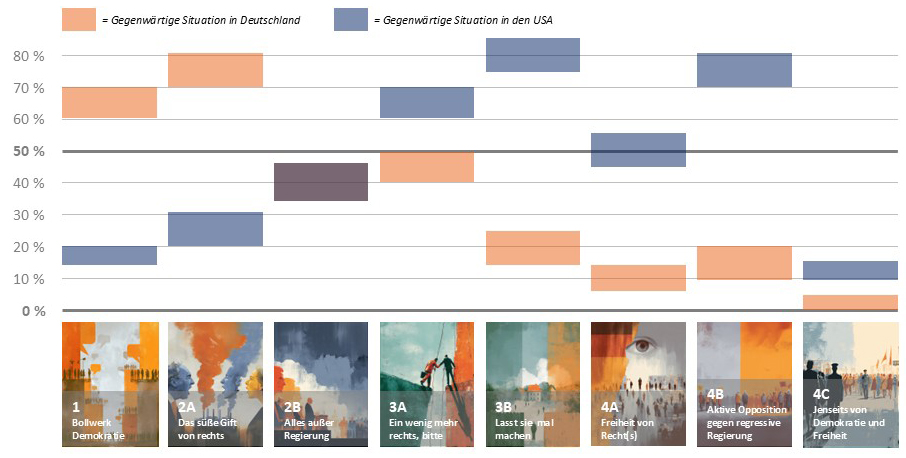
Italy, by contrast, has developed much more moderately. Despite a clearly right-wing government, the separation of powers, the Constitutional Court, the President of the Republic and parliamentary control remain largely intact. Its development is therefore concentrated around scenario 3B.
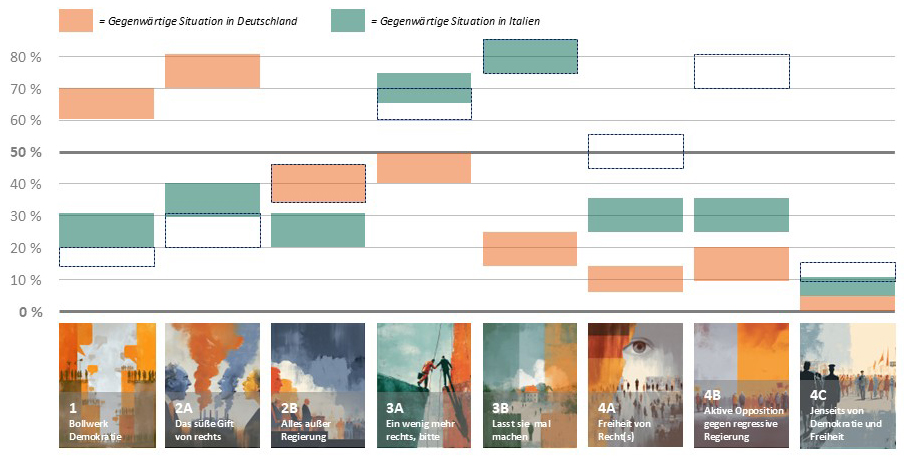
The comparison makes one point clear: participation in government alone does not determine how a democracy develops. What matters more is how governments deal with institutions, the separation of powers and political competition.
The Netherlands shows: Development is not a one-way street
The Netherlands provides a particularly interesting example. Geert Wilders’ PVV became the largest party in the 2023 parliamentary election. This subsequently led to the formation of a right-wing coalition government under the independent prime minister Dick Schoof. During his government’s term in office from 2024 until early 2026, the country shifted noticeably towards stronger institutional involvement of right-wing populist forces. Within our scenario model, the Netherlands consequently moved towards scenario 3A, and to a lesser extent towards scenario 3B.
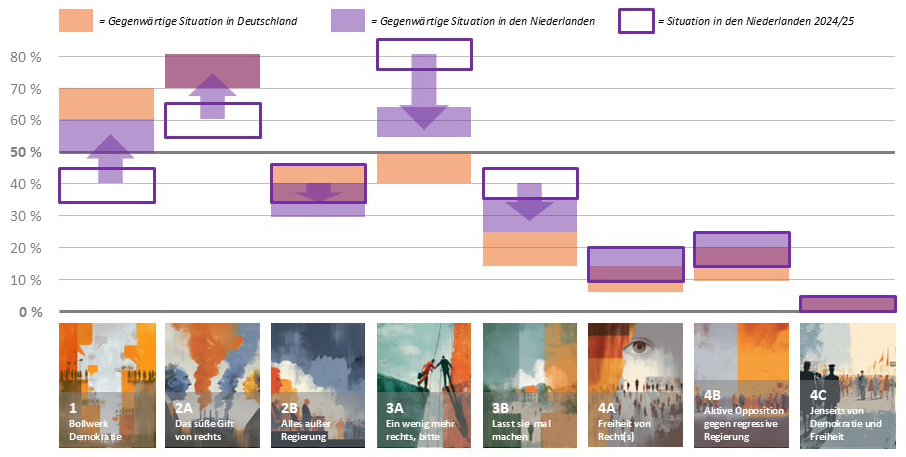
Following the end of this government and the election of Rob Jetten as prime minister, the situation changed again. The Netherlands moved closer to its earlier position within the scenario space.
The Netherlands therefore demonstrates something that is often overlooked in political debate: regressive development associated with the growing influence of right-wing populists does not necessarily move in only one direction. Political changes can also be reversed when democratic majorities change and institutions remain functional.
Poland and Hungary: A return to democracy is possible
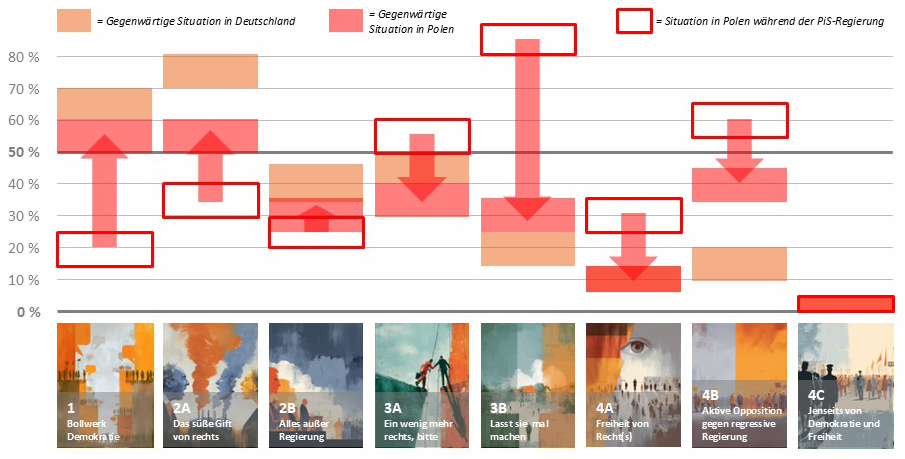
Developments in Poland and Hungary are even more striking. Under the PiS government, Poland moved well beyond scenario 3B and came increasingly close to scenario 4B, “Active opposition to a regressive government”. Following the change of government, however, the country returned to structures more firmly based on the rule of law, meaning that scenarios 1 and 2A now dominate once again. However, this development can by no means be regarded as secure.
Hungary went considerably further. Under Viktor Orbán, the country developed over many years into the European reference case for an illiberal democracy. Changes to the constitution, electoral law, the media system and state oversight institutions meant that Hungary remained clearly within the group 4 scenarios for an extended period, particularly scenario 4A, “Freedom from the right(s)”.
This is precisely why the change of government in 2026 is particularly significant. The new government under Péter Magyar explicitly aims to strengthen institutions based on the rule of law and partially reverse the institutional transformation of recent years.
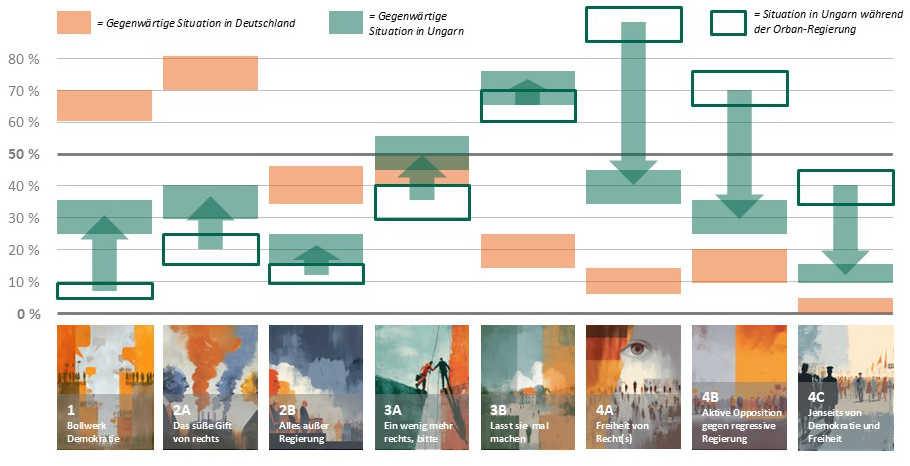
Whether this will succeed in the long term cannot yet be assessed. Rebuilding institutions based on the rule of law is considerably more difficult than dismantling them. Structurally, the group 3 scenarios therefore still dominate today, although they may represent only a transition towards a development that is once again more strongly democratic. Overall, Hungary demonstrates that even advanced democratic regression does not necessarily have to be irreversible.
What we can learn from the assessment of the Old Divides, New Dangers scenarios
First, it is important to point out three parameters of the scenarios and the scenario assessment:
The Old Divides, New Dangers scenarios are conceptual models. They never represent a specific real-world situation, but rather archetypal situations that were originally conceived as possible futures. However, they can evidently also be used to classify situations in the present and recent past.
Although the Old Divides, New Dangers scenarios were developed with a focus on Germany, they were methodologically designed in such a way that other countries can also be assessed.
The AI-supported assessment can only ever provide an approximation – although the same applies to any other form of scenario assessment. In this case, conducting the assessment at the level of the individual key factors at least ensures that all relevant variables are included.
In substantive terms, five key conclusions can be drawn from the assessment:
- The state election in Saxony-Anhalt could represent a structural break, as an AfD election victory could see Germany at least partially leave the adaptive path and instead move towards the institutional path. This would fundamentally change the way right-wing populism is dealt with.
- At the same time, a potential AfD election victory in Saxony-Anhalt would not automatically lead to authoritarian structures. A wide range of different developments could follow.
- The international comparison also shows that right-wing populist participation in government does not automatically lead to the erosion of democratic institutions or a shift towards authoritarian structures. Despite similar political starting points, there are considerable differences between the Netherlands, Italy and Hungary. One relevant aspect for Germany is that the AfD is regarded as considerably more extreme than most other right-wing populist parties in Europe.
- The international examples also show that political rhetoric alone is not decisive; institutional changes matter more. Democracies change most profoundly when the rules of political competition, the separation of powers or the independence of state institutions change. Here, the analysis highlights the scale of developments in the United States, which within a year and a half of Donald Trump’s second term show major changes towards an authoritarian transformation.
- Finally, the examples of the Netherlands, Poland and Hungary in particular show that gains in power by right-wing populists, and even the erosion of democratic foundations, can in principle be reversed. Such a return is not an automatic process. It requires functioning elections, independent institutions and an active civil society – and usually takes considerably longer than the institutional transformation that preceded it. This illustrates why Hungary could become one of the most important European test cases for the resilience of democratic systems in the coming years.
In summary, we understand the Old Divides, New Dangers scenarios not only as a conceptual model for identifying possible future developments at an early stage. They also provide a frame of reference for classifying and comparing developments in individual countries. In this sense, they can make an important contribution to structuring democratic dialogue and supporting liberal democracy more broadly.