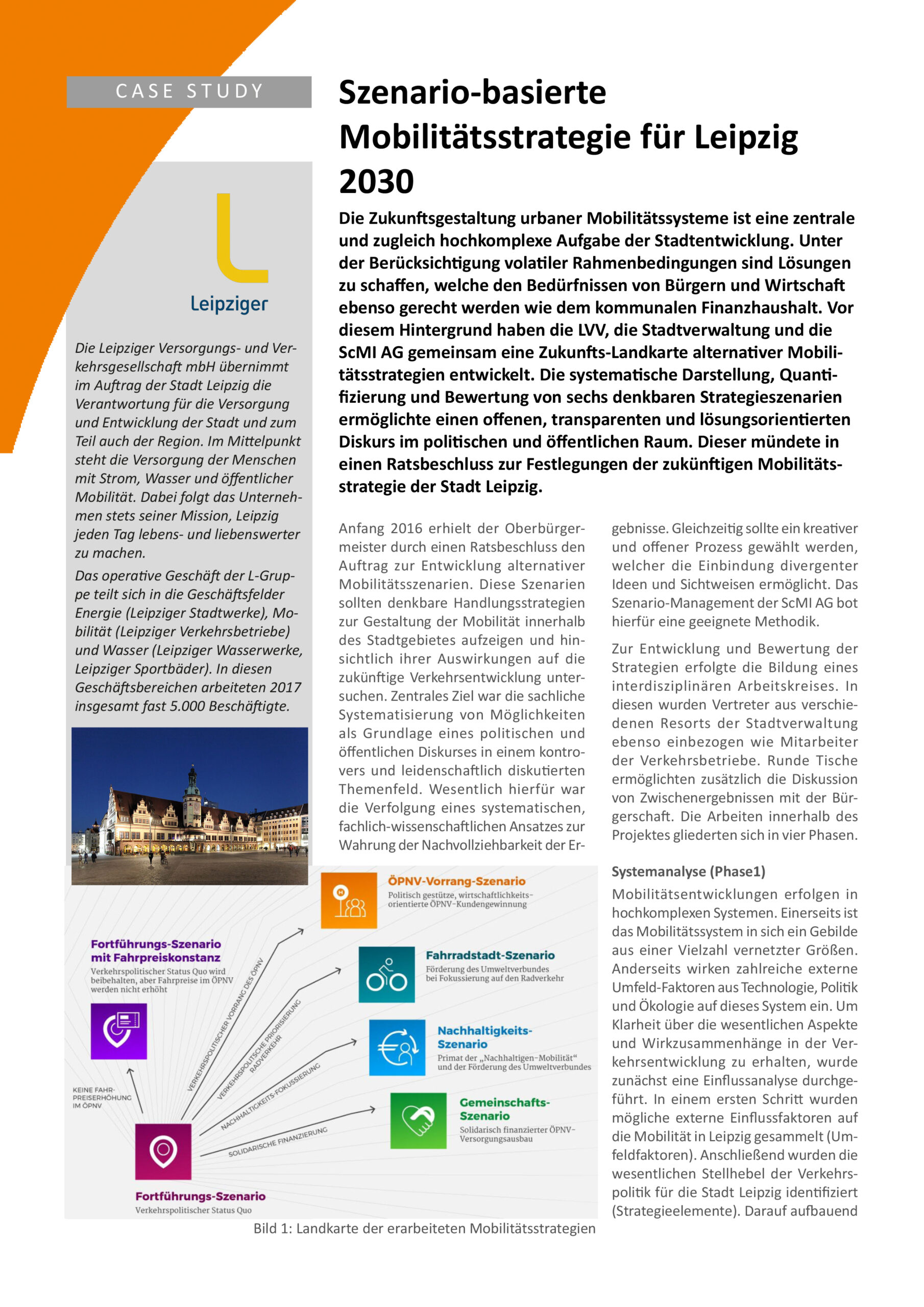
The project began with a city-council resolution to develop alternative mobility scenarios for Leipzig. The aim was to place the controversial debate about future transport development on a transparent and scientifically sound foundation. Representatives from the city administration, transport operators and other specialist departments worked together in an interdisciplinary project team. Citizens were also involved through round-table discussions, allowing different perspectives and interests to be incorporated into the development process.
The scenario process first analysed the main factors influencing future mobility and developed a shared picture of the expected external conditions. Six alternative mobility strategies were then created, combining different approaches to public transport, cycling and walking, private motorised transport, financing and infrastructure. The strategies were subsequently assessed systematically using qualitative and quantitative indicators covering environmental quality, mobility provision, quality of life and financial requirements.
The resulting map of the future created a transparent decision-making basis for policymakers and the public and enabled open dialogue about the city’s future transport development. Based on the scenario analysis, Leipzig City Council selected a sustainability scenario as the guiding vision for future mobility policy. The scenario process therefore provided not only the basis for a fundamental political decision but also for the subsequent development of concrete measures for the long-term evolution of Leipzig’s mobility system.