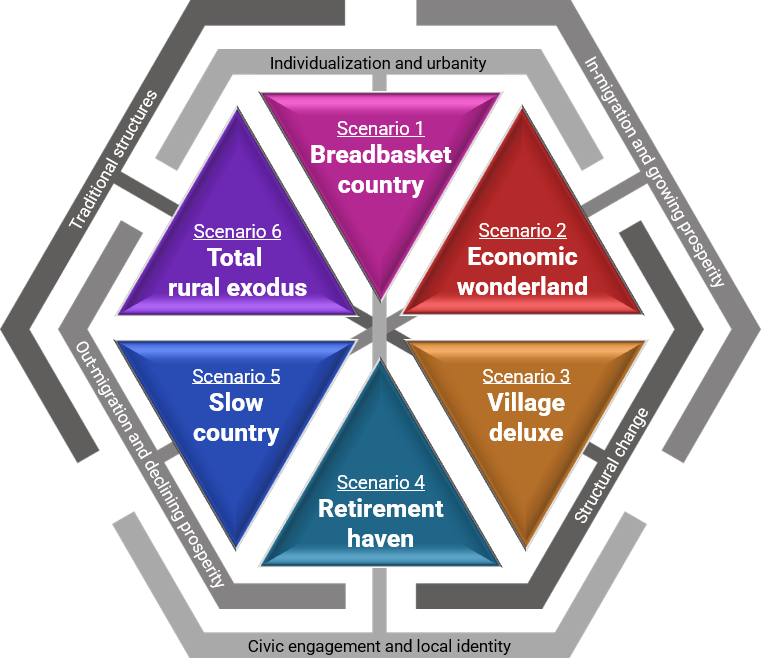
What might rural areas look like in the future? What economic and societal roles could they play? How will mobility, infrastructure and land use develop? And what prospects might emerge for municipalities, citizens and businesses? These and many other questions formed the basis of a systematic scenario process that produced six alternative future visions. They differ in their answers to three central questions:
- Can rural areas create economic opportunities and a high quality of life, thereby preventing outmigration – or even become attractive enough to generate renewed in-migration?
- Will rural economies continue to be shaped primarily by agriculture and forestry, or will significant structural change towards industry and/or services take place?
- Will rural societies become highly individualised and orient themselves towards urban models, or will civic engagement retain its above-average importance and rural areas develop distinctive identities of their own rather than primarily seeking to replicate urban life?
Combining the answers to these three core questions produces six distinct scenarios:
- Breadbasket country (Scenario 1): Rural areas establish themselves as nature-oriented places to live and relax, offering a high quality of life and comparatively low living costs. At the same time, they perform important supply functions for metropolitan areas, particularly in food production and renewable energy.
- Economic wonderland (Scenario 2): Extensive investment and economic growth strengthen rural areas. Modern infrastructure, attractive housing costs and new mobility services encourage businesses and, in particular, families to move to the countryside.
- Village deluxe (Scenario 3): Digitalisation and smart infrastructure make rural living as attractive as life in metropolitan areas. Remote working, digital services and civic engagement create new opportunities and enhance quality of life.
- Retirement haven (Scenario 4): Rural regions focus on services, tourism and offerings for an ageing society. While quality of life improves for older people, many younger people and families move to economically stronger regions.
- Slow country (Scenario 5): Economic weakness and limited development opportunities lead to a renewed focus on traditional ways of life and civic engagement. At the same time, infrastructure and innovative capacity remain limited, leaving younger people in particular with few prospects.
- Total rural exodus (Scenario 6): The gap between prosperous cities and rural regions continues to widen. Economic decline, the erosion of infrastructure and falling quality of life reinforce the outmigration of both residents and businesses.
The individual scenarios, together with the way they were developed and how they interact, are documented in a scenario study available as a free download.
Using scenarios to make robust decisions in municipalities and regions
These scenarios can serve as a starting point for open discussion about the strategic prospects and options available to municipalities and regions. They can also provide a basis for developing specific local or regional scenarios. We would be happy to provide further information on possible applications and present relevant examples.