Demographic change, the changing self-image of older people and the declining proportion of people cared for exclusively by relatives are transforming attitudes towards ageing and increasing the demand for professional care staff. The homecare market therefore demonstrates particularly clearly that change is the only constant.
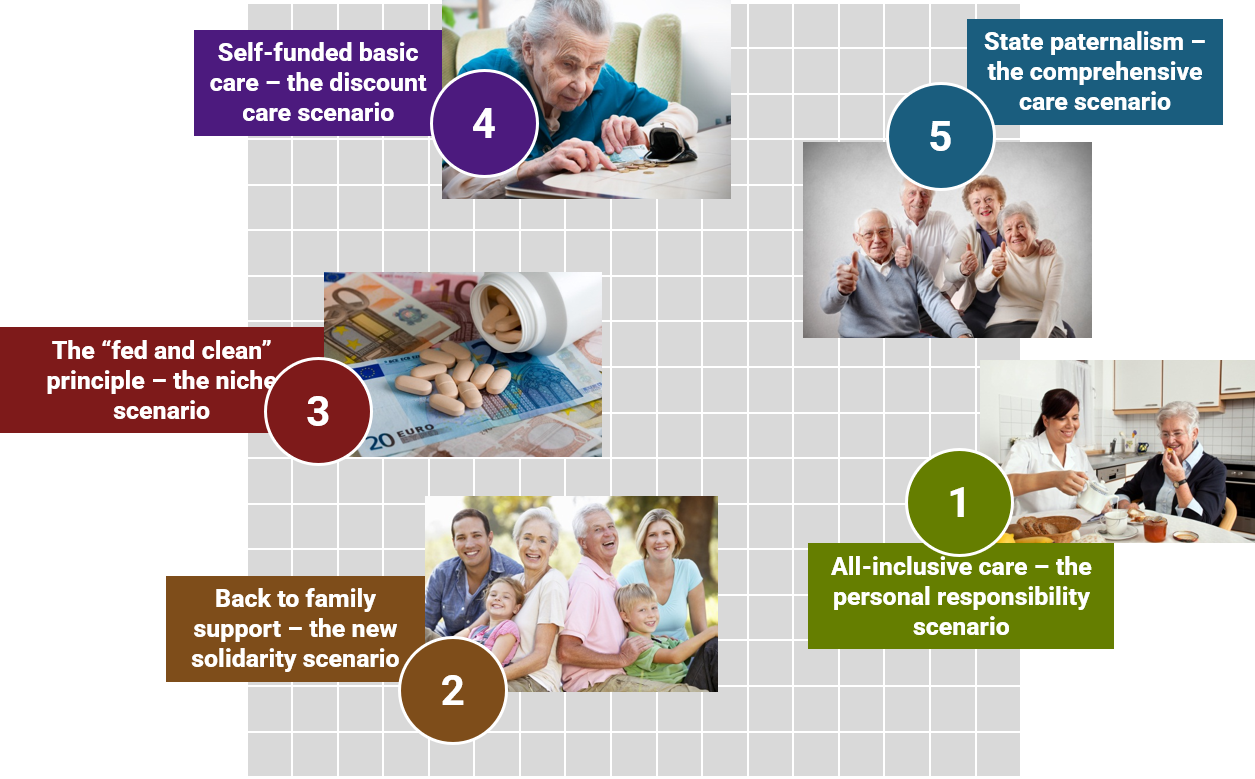
Given the many uncertainties, the future of the homecare market cannot be predicted precisely. To provide orientation for long-term decisions nevertheless, five alternative scenarios for the future of the homecare market were developed:
- All-inclusive care – the personal responsibility scenario (Scenario 1): Health has become an increasingly important issue. Health-conscious and demanding citizens frequently take control of their own care and finance professional support across all areas of life themselves. This results in strong, primarily customer-driven growth in the homecare market. The public sector supports this dynamic, privately organised industry through appropriate funding models.
- Back to family support – the new solidarity scenario (Scenario 2): People are health-conscious and demand a high degree of self-determination. At the same time, the public system provides only limited basic care, so families and social networks play an increasingly important role in supporting friends and relatives. Development of the homecare market is constrained from two directions: low public funding and insufficient private demand.
- The “fed and clean” principle – the niche scenario (Scenario 3): Homecare plays no significant role for either citizens or policymakers. Although the public sector funds a system limited in both quality and scope, it receives little attention, particularly compared with traditional care facilities. The highly regulated homecare market falls far short of expectations. It is unattractive to new competitors and business models, leaving a small number of traditional providers dominant.
- Self-funded basic care – the discount care scenario (Scenario 4): Despite material prosperity, many people suffer from unhealthy lifestyles, poor work-life balance and mental health conditions such as burnout. Health and care are postponed for as long as possible. Only then does a state-run mandatory and emergency system with substantial personal contributions step in. Within this system, homecare plays a major role because of the strong focus on costs and budgets. Growth in the homecare market is driven by external professional service providers within a system that is often difficult to navigate.
- State paternalism – the comprehensive care scenario (Scenario 5): The state assumes a broad role in organising and providing care, limiting individual choice in favour of comprehensive provision.
A broad range of companies and organisations from the homecare market contributed to developing these future visions. They included outpatient and residential care providers, manufacturers of medical products and insurers. The perspectives presented here on the future of the German homecare market in 2030 are intended as a stimulus for further thought and discussion.
Assessment of the future space
There was broad agreement in the assessment of the present situation that a continuation of current trends would lead towards the niche scenario. Views on the preferred future were equally clear: the personal responsibility scenario was considered desirable. Expectations were less clear-cut. The strongest tendency pointed towards the new solidarity scenario, although developments towards Scenario 3, the niche scenario, and Scenario 4, the discount care scenario, were also identified.