One of the core responsibilities of Frontex, the European agency responsible at the time for coordinating operational cooperation at the EU’s external borders, was to coordinate cooperation between the border police forces of the Member States in protecting the EU’s external borders and to harmonise the training and professional development of border guards. In this context, Frontex prepared risk analyses on irregular migration and published them annually in its Risk Analysis Report.
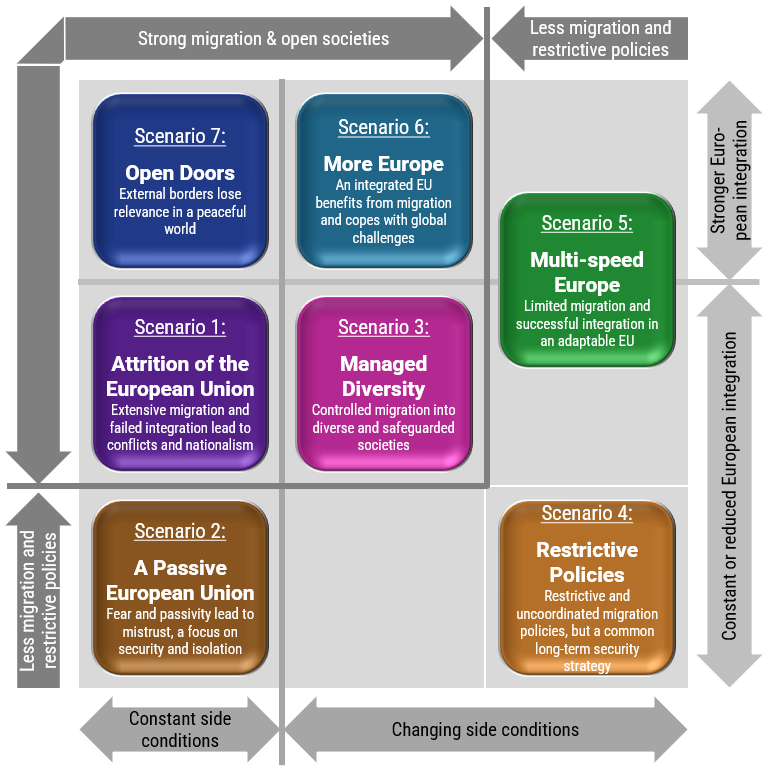
For the first time, Risk Analysis 2016 included a longer-term foresight component alongside its situation analysis and examination of specific topics. Frontex was supported by ScMI AG in developing this outlook. The scenario process involved representatives from several Frontex departments, delegates from a number of EU Member States, including Finland, Germany, Greece and the Netherlands, as well as representatives of organisations such as Europol, EASO, FRA, the European Commission, the EEAS, EU INTCEN, UNHCR and the OECD’s Migration Division. The process produced seven possible scenarios:
- Attrition of the European Union (Scenario 1): Extensive migration and failed integration lead to conflicts and nationalism.
- A Passive European Union (Scenario 2): Fear and passivity lead to mistrust, a focus on security and isolation.
- Managed Diversity (Scenario 3): Controlled migration into diverse and safeguarded societies.
- Restrictive Policies (Scenario 4): Restrictive and uncoordinated migration policies, but a common long-term security strategy.
- Multi-speed Europe (Scenario 5): Limited migration and successful integration in an adaptable EU.
- More Europe (Scenario 6): An integrated EU benefits from migration and copes with global challenges.
- Open Doors (Scenario 7): External borders lose relevance in a peaceful world.
These scenarios are conceptual models and were not assigned probabilities. To make them usable in strategy and planning processes, they were assessed in a second step. The situation at the time was represented most closely by Scenario 2, A Passive European Union, although Scenario 4, Restrictive Policies, also contained a number of present-day elements.
Looking ahead, the experts considered Scenarios 2, 4 and 5, Multi-speed Europe, the most likely – in other words, a continued development towards restrictive policy approaches and limits on migration. This was associated with a more substantially changing geopolitical environment that would require a proactive European foreign policy and joint protection of the EU’s external borders.