Commissioned by the Bavarian State Ministry of Food, Agriculture and Forestry, the Food Cluster, the Competence Centre for Nutrition (KErn) and a panel of 17 experts developed and assessed scenarios for the future of the food industry and presented them at the Future of Food Days.
Scenario development focused in particular on the following key uncertainties:
- How strongly will policymakers intervene in the food environment in the future?
- How innovative will the food industry be in the future?
- How strongly will global free trade and digitalisation shape the future food industry?
- What roles will values, regionality and quality play in the future food industry?
- To what extent will individual customer behaviour drive market-led innovation?
- To what extent will the food industry be able to generate innovation from within?
The scenarios provide possible answers to these and many other questions. The study developed and described eight scenarios in total.
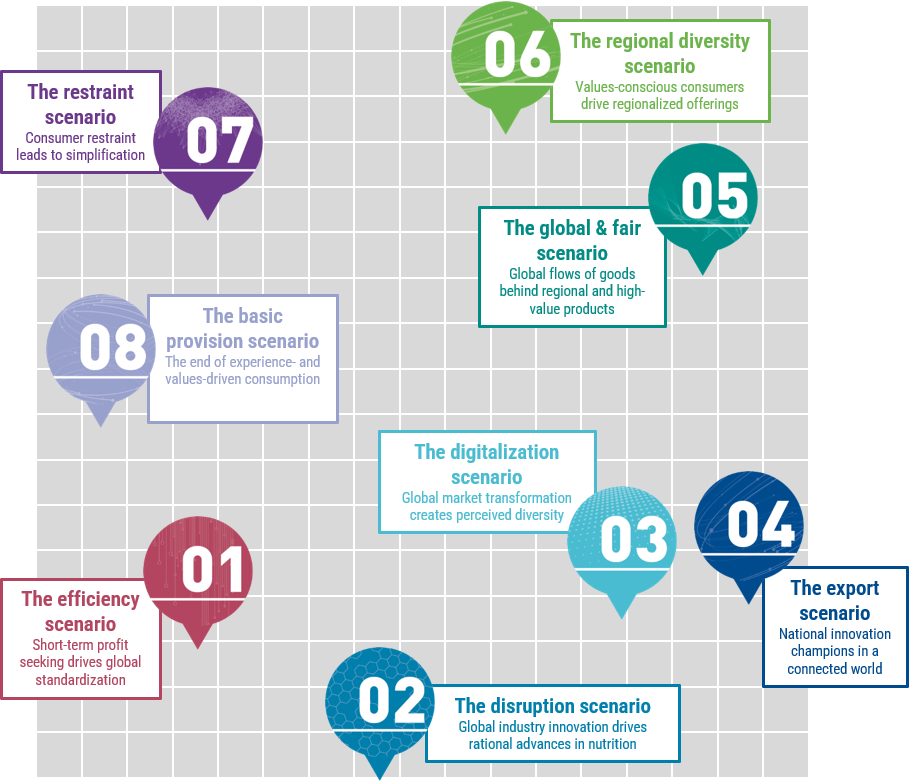
- The efficiency scenario – Short-term profit seeking drives global standardization (Scenario 1): Global corporations dominate the food industry. Efficiency and cost leadership take centre stage, while product diversity and long-term innovation lose importance.
- The disruption scenario – Global industry innovation drives rational advances in nutrition (Scenario 2): New technologies and scientific advances fundamentally transform the food industry. Innovation is driven primarily by large international companies.
- The digitalization scenario – Global market transformation creates perceived diversity (Scenario 3): Digitalisation enables highly individualised products and new business models. Despite the wide range of offerings, the food industry remains strongly globalised.
- The export scenario – National innovation champions in a connected world (Scenario 4): Medium-sized companies use their innovative strength and flexibility to serve specialised markets successfully around the world. Germany maintains its strong position as an export location.
- The global & fair scenario – Global flows of goods behind regional and high-value products (Scenario 5): Sustainability, values and regionality shape consumption. At the same time, global supply chains and international connectivity remain important foundations of the food industry.
- The regional diversity scenario – Values-conscious consumers drive regionalized offerings (Scenario 6): Regional products, transparency and traditional structures gain considerable importance. Innovation is driven mainly by consumer needs and regional markets.
- The restraint scenario – Consumer restraint leads to simplification (Scenario 7): Sustainability and reduced consumption become defining social principles. Regional self-sufficiency and direct marketing gain importance, while global innovation recedes into the background.
- The basic provision scenario – The end of experience- and values-driven consumption (Scenario 8): Security of supply becomes the central objective. National markets, limited product variety and reliable basic provision shape the food industry.
After the scenarios had been developed, the future visions were assessed. The results show that the future of the food industry cannot be reduced to a single scenario. Expected developments combine digitalisation, individualisation and value-oriented consumption while allowing for a high degree of diversity in products and business models.
At the same time, the assessment shows that regionality, sustainable innovation and a value-oriented food system are regarded as particularly desirable. The scenarios therefore provide a sound basis for systematically discussing alternative development paths, identifying opportunities and risks at an early stage, and preparing more robust strategic decisions under conditions of uncertainty.