Given the uncertainty surrounding future AI development and its embedding in a complex system of technological, economic, political and societal influences, it is not enough to consider only one expected or preferred future. Instead, different possible futures need to be explored in greater depth. For this purpose, the methodology of Scenario Management was applied.
The future space spanned by the six scenarios can be described along three core dimensions: AI’s learning capability and augmentation potential (x-axis), the role of different actors in AI development (y-axis), and changes in the world of work (dashed line). At the outer edges of this possibility space, one clearly negative and one more utopian contrast scenario emerge. Between these two extremes lie four additional future visions, each with its own profile of opportunities and risks:
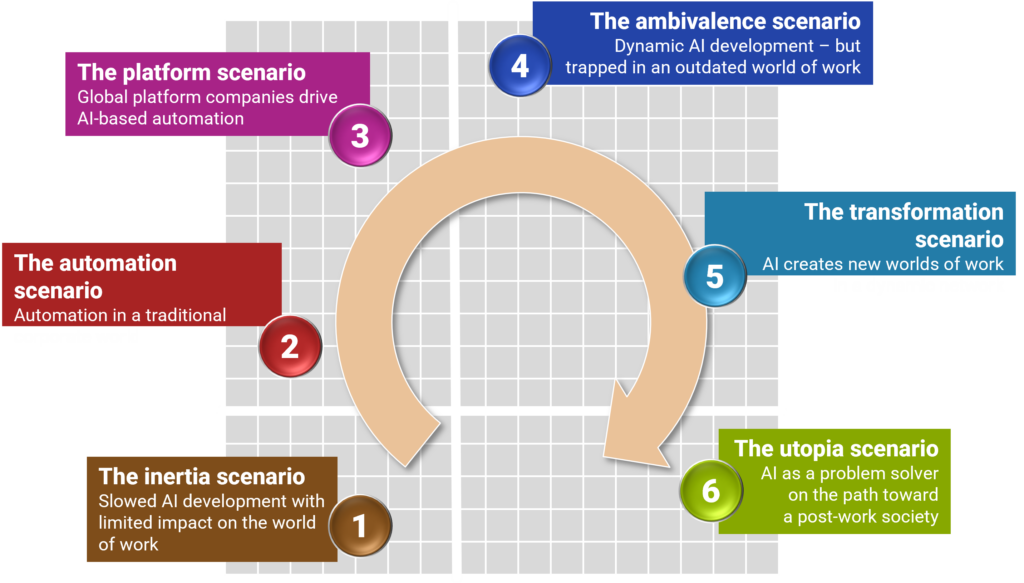
The six scenarios can be described as follows:
- Inertia Scenario – Constrained AI Development with Limited Impact on the World of Work (Scenario 1): AI develops and is adopted only slowly, leaving much of its potential in business and the world of work untapped. While other regions of the world make major advances, Europe increasingly loses competitiveness.
- Automation Scenario – Automation in a Traditional Corporate World (Scenario 2): AI is used primarily to improve efficiency in established industrial companies. Rigid organisational structures and a closed data economy, however, inhibit innovation and new business models.
- Platform Scenario – Global Platform Companies Drive AI-Based Automation (Scenario 3): International platform companies shape AI development and dominate access to data and digital business models. At the same time, flexible, project-based forms of employment become increasingly important in a platform economy.
- Ambivalence Scenario – Dynamic AI Development, but Trapped in the Old World of Work (Scenario 4): Powerful AI changes human–technology interaction, but remains embedded in traditional corporate and leadership structures. Automation and efficiency dominate, while the potential to enhance human work is only partly realised.
- Transformation Scenario – AI Creates New Work Environments in a Dynamic Network (Scenario 5): AI supports the transition towards a connected, sustainable and human-centred world of work. New fields of activity, lifelong learning and self-organising corporate structures shape this transformation.
- Vision Scenario – AI as a Problem Solver on the Path towards a Post-Employment Society (Scenario 6): AI unfolds its full potential in an open knowledge society and lays the foundation for a highly productive economy. Paid employment becomes less central, while new forms of social participation and social protection emerge.
In an online survey, experts assessed the scenarios according to their proximity to the present, their likelihood for 2030 and their desirability.
Scenarios 1 and 2 are considered closest to the present, since the digital diffusion of work and the performance and learning capabilities of AI are still seen as relatively moderate today. Job substitution as a negative consequence of AI – as described in Scenario 1 – is also still regarded as comparatively limited at present. At the same time, the risks described in Scenario 2 already shape today’s AI debate. Innovation in the field of AI is currently driven primarily by global corporations. In addition, today’s working world still largely reflects the traditional structures described in Scenarios 1 and 2, with comparatively hierarchical forms of organisation.
For 2030, experts expect developments corresponding to Scenarios 2 to 5. Digital diffusion and the use of AI are both expected to increase. At the same time, all expected scenarios are characterised by a corporate landscape dominated by large companies, in which major platforms drive AI development. The fact that the expected future space spans four scenarios also highlights the high degree of uncertainty surrounding which future will actually emerge.
From the experts’ perspective, Scenario 5 comes closest to the preferred future of an AI-based world of work, although Scenarios 4 and 6 also share many desirable characteristics. Overall, the preferred future is one in which AI does not primarily lead to substitution and automation, but instead has a strong augmentation component in the sense of enriching, supporting and extending human activities. The increasingly digital and AI-enabled world of work should also be embedded in an open data environment with strong data sovereignty, and control over AI should not rest solely with major platform companies. Experts therefore favour a flexible world of work in which companies demonstrate a greater capacity for change within a dynamic, decentralised and more self-organising network environment.