How will digitalisation affect our town and city centres? How do town and city centres influence our quality of life? What role will sustainability play in society, and what functions will urban centres perform in the future? These and other questions were explored in the scenarios and visualised on a Map of the Future. The eight scenarios address four core areas: economic development and digitalisation; quality of life and citizen participation; sustainability and municipal policy; and retail and the traditional marketplace function of town and city centres.
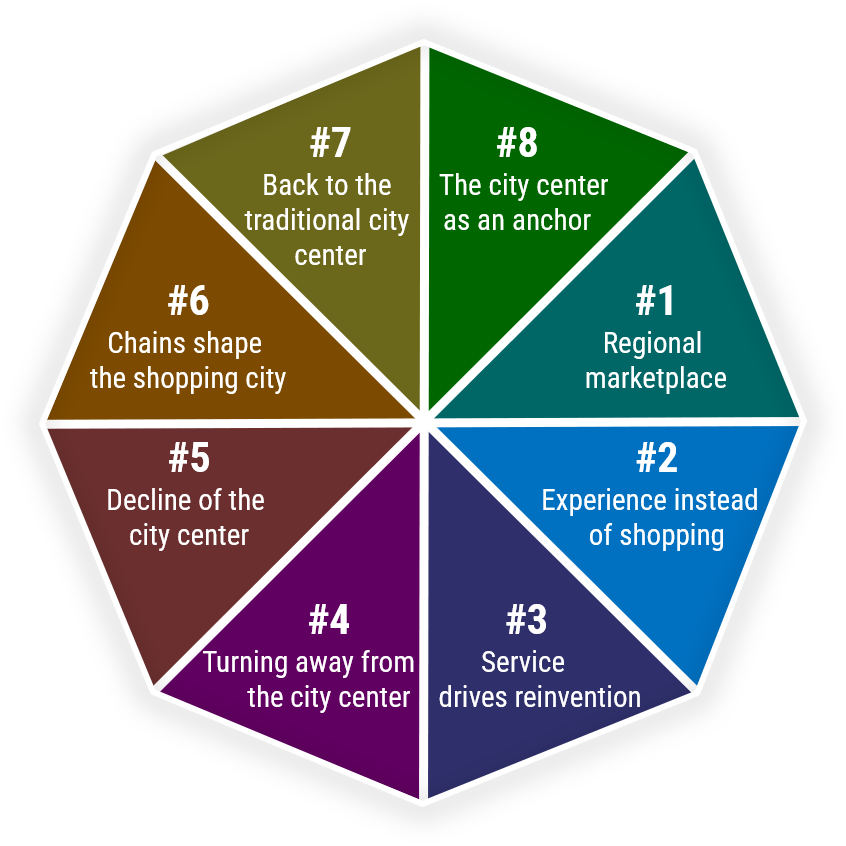
Which scenarios emerge on the Map of the Future?
- Regional marketplace (Scenario 1): The town or city centre develops into an attractive meeting place for residents and visitors. Regional retail, hospitality and leisure offerings complement one another, creating a vibrant centre with a high quality of place and a strong local identity.
- Experience instead of shopping (Scenario 2): The traditional shopping function loses importance, while experiences, leisure and services increasingly shape the centre. It becomes more of a place for encounters, while purchases are increasingly made online.
- Service drives reinvention (Scenario 3): The centre reinvents itself, evolving from a retail location into a place for services and municipal offerings. Retail and hospitality recede, while services and mixed uses become more important.
- Turning away from the city center (Scenario 4): Digitalisation and virtual offerings replace many of the centre’s traditional functions. Despite favourable economic conditions, the physical city centre loses considerable importance.
- Decline of the city center (Scenario 5): Economic and societal developments lead to a significant loss of importance. Retail, services and the quality of public space decline, and the centre is no longer able to fulfil much of its traditional role for the municipality.
- Chains shape the shopping city (Scenario 6): The centre remains a shopping destination but is increasingly dominated by chain stores and retail groups. Regional diversity and distinctive local offerings give way to standardised retail structures.
- Back to the traditional city center (Scenario 7): The centre retains its traditional role as a marketplace and shopping district. Established structures largely remain in place and are deliberately strengthened through municipal measures.
- The city center as an anchor (Scenario 8): The centre develops into the social heart of the municipality. Encounters, participation and community life take centre stage, making it an identity-forming place for residents, businesses and families.
After the eight scenarios had been developed, the findings were systematically evaluated for the participating towns and cities: Arnsberg, Iserlohn, Lüdenscheid, Siegen, Soest, Meschede, Olpe, Schmallenberg, Lennestadt, Sundern, Brilon, Meinerzhagen, Bad Berleburg, Kreuztal, Werdohl, Hilchenbach, Hallenberg, Olsberg, Marsberg, Balve, Drolshagen, Bad Laasphe, Kirchhundem and Winterberg. The analysis examined which future visions appeared particularly plausible or desirable for different types of municipality and regional conditions.
A cross-cutting analysis then highlighted similarities and differences between the municipalities. It showed that economic conditions, quality of life, citizen participation, sustainability and the future role of retail are key levers shaping town and city centres. At the same time, there is no single future vision: depending on size, economic structure, tourism and location, different but equally plausible development paths emerge. Scenarios that develop the centre as a vibrant place for encounters and complement its traditional marketplace function with new experiences, services and higher-quality public spaces were rated particularly positively.