The project set out to create a shared understanding of the future among tourism stakeholders from business, academia and politics. It deliberately did not seek to identify a single most likely future. Instead, the aim was to develop different internally consistent future visions that would make opportunities, risks and strategic options for tourism in Bavaria visible and stimulate debate about its long-term development.
The scenario process was driven by an interdisciplinary team of twenty experts from destinations, hotels, restaurants, tourism associations, mobility providers, the creative industries and tourism research. Their diverse perspectives ensured that the scenarios captured the full range of possible developments in tourism. Particular attention was paid to digitalisation, sustainability, growth, industry structure and tourism policy.
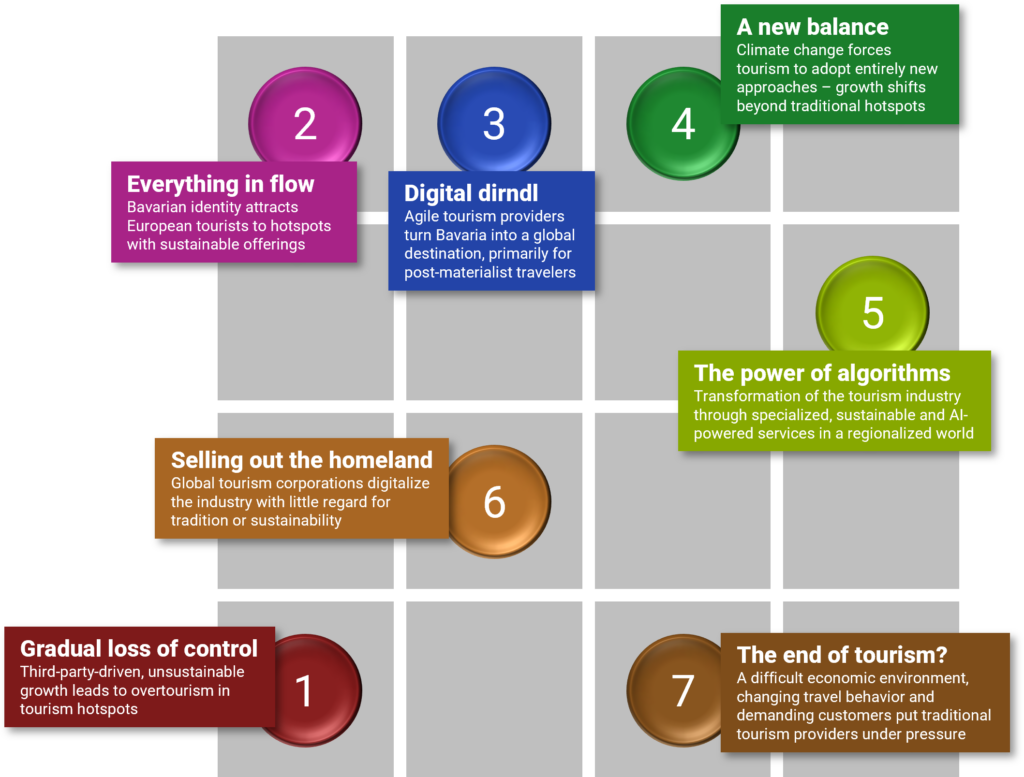
Together, the seven scenarios form a Map of the Future and show alternative development paths for tourism in Bavaria through to 2040.
Scenarios
- Gradual loss of control – Third-party-driven, unsustainable growth leads to overtourism in tourism hotspots (Scenario 1): Bavaria initially continues to benefit from its strong reputation, but increasingly loses ground to more dynamic tourism regions. A lack of innovation and unmanaged growth lead to overtourism, declining authenticity and growing pressure on local communities.
- Everything in flow – Bavarian identity attracts European tourists to hotspots with sustainable offerings (Scenario 2): Positive economic development enables active tourism policy and targeted visitor management. Sustainable offerings, a strong regional identity and a balanced relationship between tourism and local communities strengthen Bavaria’s appeal as a destination.
- Digital dirndl – Agile tourism providers turn Bavaria into a global destination, primarily for post-materialist travelers (Scenario 3): Digitalisation and innovative partnerships shape tourism value creation. Authentic experiences, sustainability and intelligent digital services make Bavaria an internationally successful destination.
- A new balance – Climate change forces tourism to adopt entirely new approaches – growth shifts beyond traditional hotspots (Scenario 4): Sustainability becomes the central guiding principle for tourism development. Growth increasingly depends on environmental compatibility, regional value creation and a more balanced distribution between hotspots and the wider region.
- The power of algorithms – Transformation of the tourism industry through specialized, sustainable and AI-powered services in a regionalized world (Scenario 5): Artificial intelligence fundamentally changes business models and tourism offerings. Data-driven services and digital platforms increasingly dominate competition, while regional identity loses importance.
- Selling out the homeland – Global tourism corporations digitalize the industry with little regard for tradition or sustainability (Scenario 6): Economic and environmental challenges push long-term tourism issues out of focus. International platforms and corporations shape the market and put increasing pressure on regional providers.
- The end of tourism? – A difficult economic environment, changing travel behavior and demanding customers put traditional tourism providers under pressure (Scenario 7): Persistent economic difficulties and declining international appeal lead to a marked fall in tourism. The industry concentrates on preserving existing structures, while innovation largely stalls.
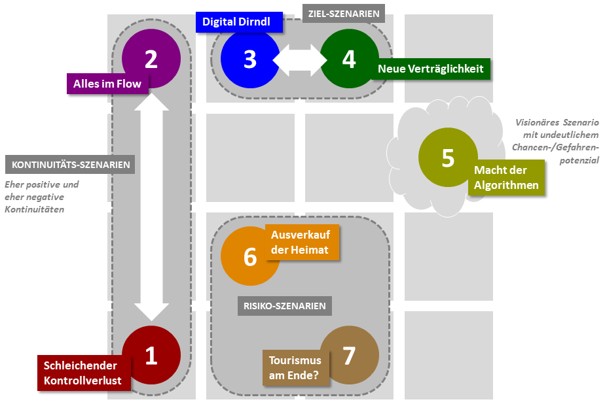
After the scenarios had been developed, the future visions were assessed in terms of their proximity to the present and their closeness to an expected and a preferred future. Gradual loss of control and Everything in flow form the present-day space, while Digital dirndl and A new balance lie at the heart of the preferred-future space. Selling out the homeland and The end of tourism?, by contrast, represent critical developments that should ideally be avoided. The power of algorithms occupies a special position as a visionary future and highlights the far-reaching effects technological developments could have over the long term.
The scenarios show that the future of tourism in Bavaria will not follow a single development path. Rather, it will be shaped by the interaction of digitalisation, sustainability, economic development and societal expectations. A central tension emerges between continued tourism growth and the long-term compatibility of destination development. The scenarios help destinations, tourism businesses, associations and policymakers discuss different future developments systematically, identify opportunities and risks at an early stage, and position tourism in Bavaria for long-term resilience, sustainability and competitiveness.