There are many questions about the future of business, society and politics after the COVID-19 pandemic:
- What will companies and industries look like?
- Will the pandemic lead to deglobalisation and shorter supply chains, will multilateral cooperation gain greater acceptance as a way of solving problems – or will both developments interact?
- Will working practices change significantly?
- Will solidarity within societies and between countries gain or lose importance?
- Will societal and political views of essential public services change – and what will this mean for regulation, the role of government and, more specifically, our healthcare system?
- And will society be dominated by a desire for a new normal – or by a desire for change, whatever direction it may take?
ScMI AG explored these and many other questions with 80 experts in an open online process, developing eight Post-COVID Scenarios and bringing them together on a Map of the Future.
The eight Post-COVID Scenarios are not forecasts, but tools for thinking. They are intended to help decision-makers in companies, organisations and public institutions make better decisions in situations characterised by exceptionally high uncertainty:
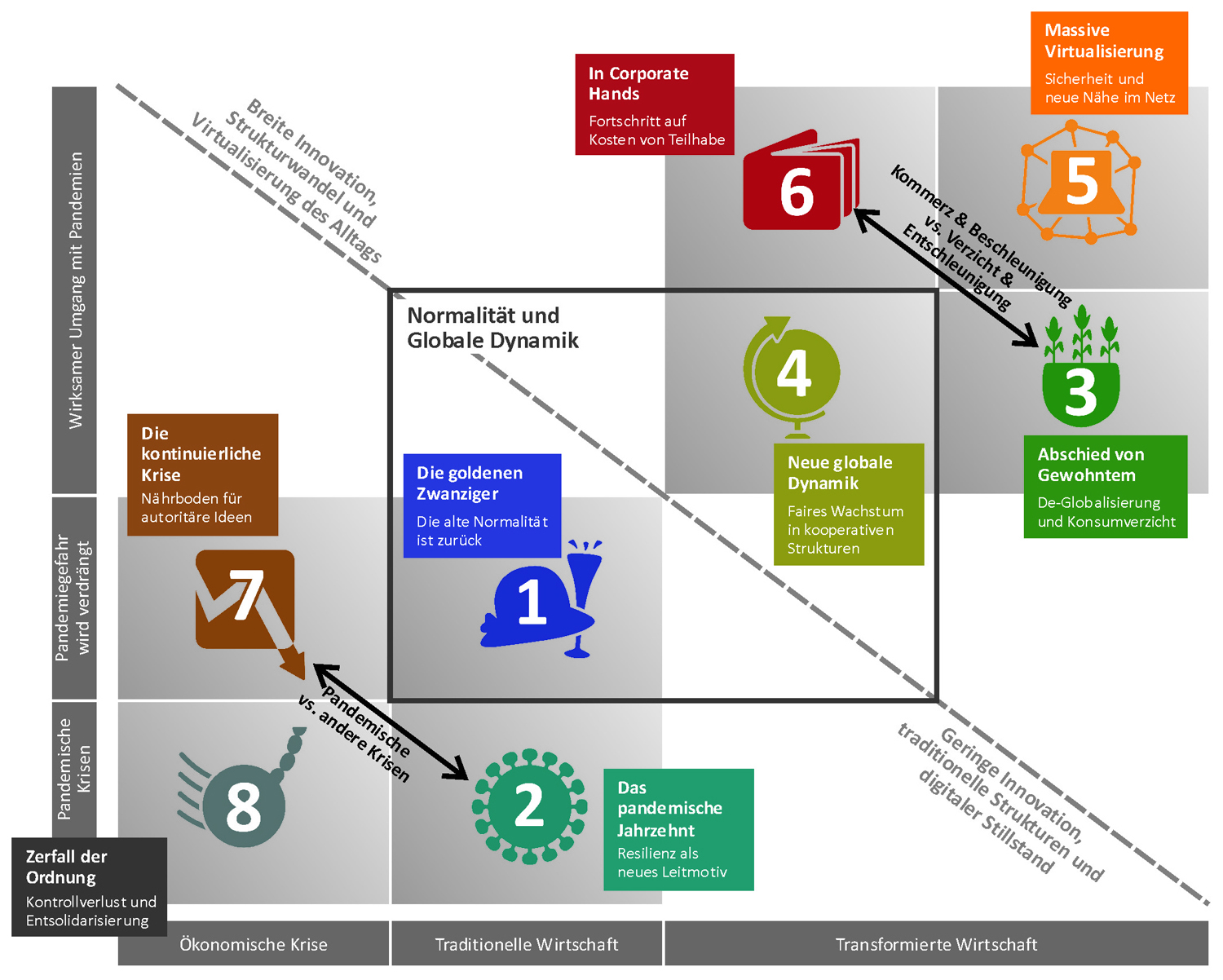
- The golden twenties: The old normal is back (Scenario 1): Driven by a resurgence in free trade and people’s desire for their old lives, the traditional economy operates at full speed – accompanied by a deceptive sense of carefreeness.
- The pandemic decade: Resilience as the dominant guiding principle (Scenario 2): Government and the healthcare system become drivers of resilience and sustainability in response to recurring pandemic threats, while innovative capacity declines and large parts of the traditional economy repeatedly come under pressure.
- Farewell to the familiar: Deglobalization and reduced consumption (Scenario 3): A shift in values towards sustainability and regionality, combined with strongly interventionist government policy, shapes structural change and leads to a substantial reduction in consumption.
- New global dynamics: Fair growth in cooperative structures (Scenario 4): Sustainable transformation, open knowledge systems and fair global cooperation enable renewed global growth.
- Massive virtualization: Security and new forms of closeness online (Scenario 5): The virtualisation of large parts of everyday and working life becomes the new normal, creating a framework for safe, informed and internationally connected coexistence.
- In corporate hands: Progress at the expense of participation (Scenario 6): The crisis triggers a surge in innovation. Global corporations increasingly dominate at the expense of politically and financially weak nation states, while societal disparities grow across the board.
- The continuous crisis: A breeding ground for authoritarian ideas (Scenario 7): A prolonged crisis leads to stagnation, declining entrepreneurial confidence and fear of downward mobility, allowing authoritarian forces to gain influence in a deglobalised environment.
- Collapse of order: Loss of control and erosion of solidarity (Scenario 8): New pandemics and a global economic crisis destabilise states and financial systems, leading to widespread erosion of solidarity and the emergence of a clan-based society.
In an initial assessment in May 2020, all eight Post-COVID Scenarios still had almost identical expected-future scores. Uncertainty during the first months of the pandemic was exceptionally high. A more extensive assessment involving respondents from business, academia, futures research and consulting, as well as young people, in autumn and winter 2020 produced a more differentiated picture.
The experts expected the 2020s to bring substantial structural change in business and society. This included faster innovation, significant changes in economic structures, working practices and consumption patterns, as well as a massive virtualisation of everyday life. A key driver of this transformation was expected to be the climate crisis, which had temporarily receded from public attention during the pandemic but was likely to force governments, businesses and consumers to reset their priorities in the post-COVID period.
The results of the open online scenario process are summarised in a study available as a free download.