Agriculture and the food industry form the economic backbone of north-western Lower Saxony. Few other regions in Germany are as strongly shaped by farming, food processing and the associated value-creation networks. The region also plays a key role in Germany’s agricultural and food sectors as a whole. Changes in regulatory, technological or social conditions therefore have significant consequences not only for north-western Lower Saxony itself, but for the entire sector.
The project “TRAIN – Transformation Scenarios for Agriculture and Food in Lower Saxony” brought together the Transformationsforschung agrar Niedersachsen research network, ScMI AG and the Hamburg Institute of International Economics (HWWI). Working closely together, they aimed to systematically describe possible development pathways for the sector and estimate their regional economic consequences. The scenarios were developed through a broad participatory process involving representatives from agriculture, the food industry, academia, politics, public administration and civil society organisations.
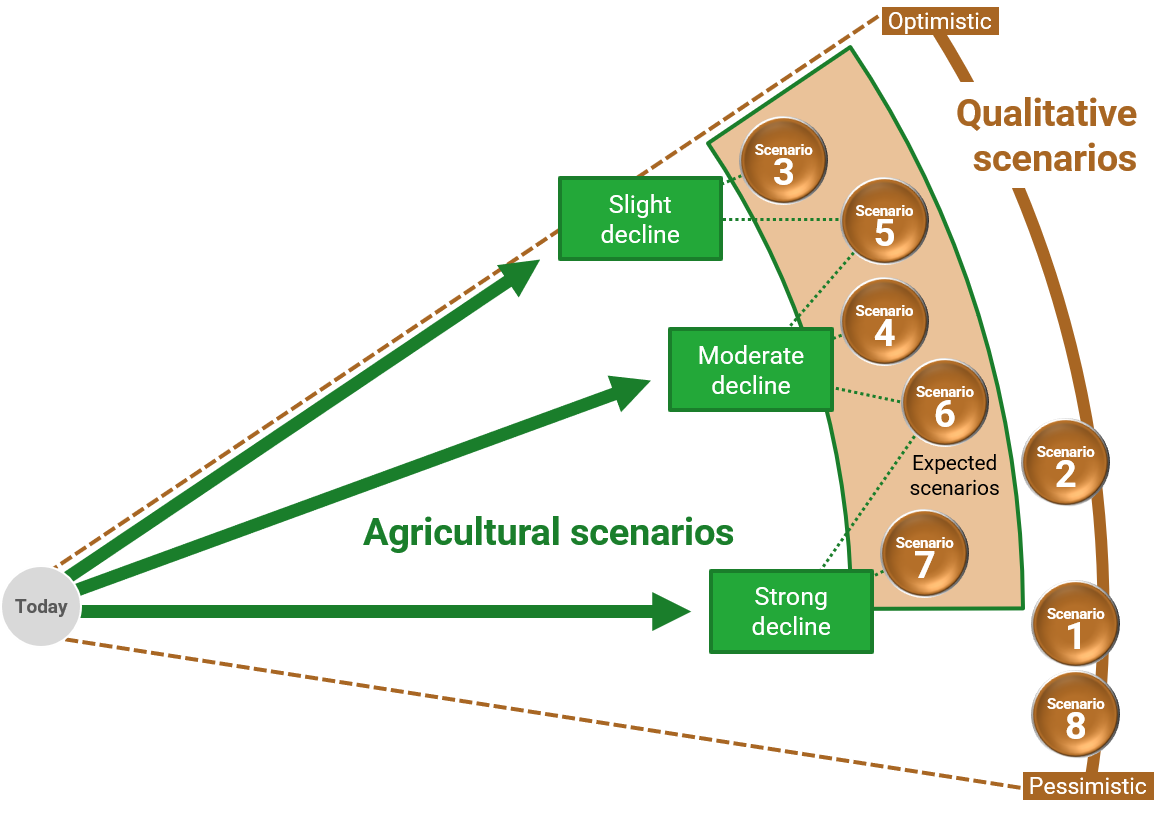
The study is based on eight qualitative scenarios that combine key drivers in different ways. These include regulatory conditions, consumer behaviour, technological innovation, globalisation, digitalisation and climate change. Positioned on a Map of the Future, the scenarios illustrate the range of possible transformation pathways for agriculture and the food industry in Lower Saxony up to 2035.
Scenario overview
- Agriculture Is Pulled into the General Downturn (Scenario 1): Rigid structures constrain development in north-western Lower Saxony. Agriculture loses momentum and competitiveness as the wider economy declines.
- Innovative Agriculture in a Market-Driven Environment (Scenario 2): North-western Lower Saxony pursues success in global competition, but must accept further concentration within its agricultural sector.
- Consumers Drive Change (Scenario 3): Growing demand for high-quality food opens up new opportunities in global premium markets for an agricultural sector dominated by small and medium-sized enterprises.
- Policy Shapes Change – Despite Persistent Behaviour Patterns (Scenario 4): Regulation drives the transformation of agriculture, while consumer behaviour changes only slowly.
- Sustainable Agriculture with a Global Perspective (Scenario 5): Policymakers, society and business jointly shape a comprehensive transformation towards an agricultural sector that is both sustainable and internationally competitive.
- A Broader Role for Agriculture in an Innovative Rural Region (Scenario 6): Agriculture becomes part of a more diverse regional economy and rural community, with new opportunities for value creation.
- Agricultural Transition as a Green Go-It-Alone Strategy (Scenario 7): A determined shift towards environmentally sustainable farming leads to a far-reaching transformation of agriculture and regional value creation.
- Re-Nationalisation and Subsistence Orientation in Agriculture (Scenario 8): Protectionism and declining export opportunities force agriculture to focus more strongly on national and regional markets.
From qualitative scenarios to quantitative future visions
Following qualitative scenario development, the future visions were systematically assessed. Five of the eight scenarios emerged as particularly plausible development pathways suitable for more detailed analysis. For these scenarios, validation with practitioners was used to establish quantitative ranges for key indicators such as livestock numbers, market output and benchmark gross margins. These results formed the basis for three agricultural transformation scenarios involving slight, moderate or strong declines in livestock numbers and market output.
These quantified scenarios subsequently formed the basis for extensive macroeconomic modelling. Regional economic simulations were used to analyse the effects on value added, employment and the economic development of Lower Saxony. This linked the qualitative future visions to robust economic estimates and made their implications for different regions and subsectors transparent.
Options for policymakers and business
Based on the scenarios and quantitative analyses, specific recommendations were developed jointly with the participating stakeholders. They address the European, national, state and municipal levels and show how the transformation process can be actively shaped. The measures focus on strengthening competitiveness, supporting sustainable production methods, safeguarding regional value creation and helping the sector manage structural change. The study therefore provides a practical frame of reference for strategically guiding the long-term transformation of agriculture and the food industry.