
Social, technological and economic change – and climate change in particular – pose major challenges for Bavaria’s agriculture, forestry and food sectors. Vegan and vegetarian diets are moving from the niche into the mainstream, while sustainability in all its dimensions is reshaping food production across the value chain from field to plate. In this environment, alternative protein sources are an innovative addition to the range of possible solutions to challenges such as health, climate protection and animal welfare. Insect farming and plant-based substitutes, for example, can require comparatively little land and generate low CO2 emissions. Alternative proteins are also attracting economic interest from companies, start-ups and investors. At the same time, many questions remain unanswered – not least whether what is technically possible will also be accepted by society.
To raise awareness among actors in Bavaria’s agriculture and food sectors of future structural change and support strategic decision-making, the Competence Center for Nutrition (KErn) initiated a dedicated scenario process. Together with experts from business, academia and public administration, ten possible scenarios were developed and visualised on a map. The scenarios can be differentiated through three core questions: How disruptive is the scenario? How important is sustainability? And how strong is food innovation, especially the role of novel foods?
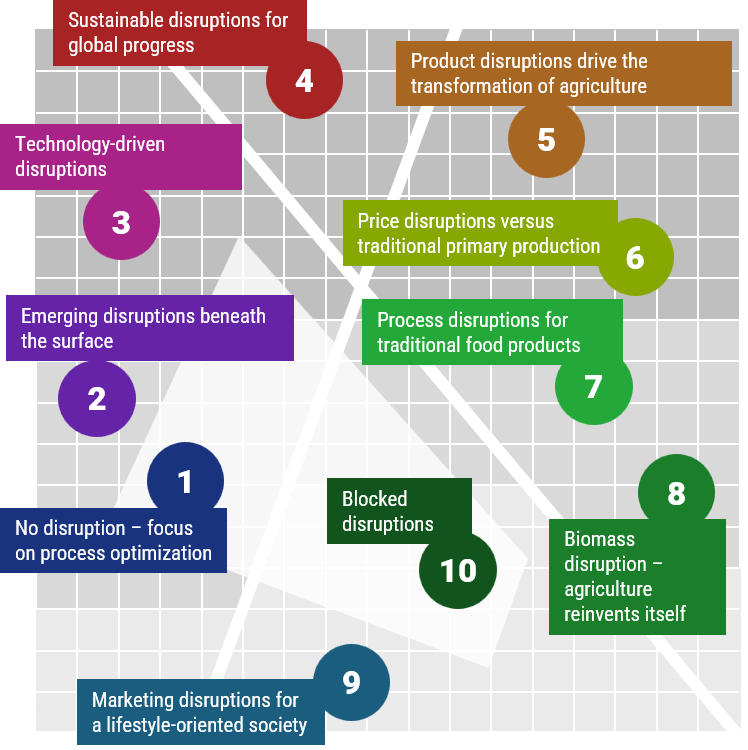
Which scenarios emerge on the map?
• No Disruption – Focus on Process Optimisation (Scenario 1): Society and policymakers show little willingness to change, so the agriculture and food sector experiences no need for disruption. Food producers concentrate on incremental process innovation to gain price advantages.
• Disruption Germinating Below the Surface (Scenario 2): Political calls for innovative approaches in primary production and sustainable food production are circumvented by slow-moving traditional actors, while new players and start-ups seek opportunities.
• Technology-Driven Disruption (Scenario 3): Food production becomes highly technology-intensive. Both intensive primary production – including the use of synthetic biomass – and downstream biomass-processing operations are designed for maximum efficiency and generate new products that achieve broad acceptance.
• Sustainable Disruption for Global Progress (Scenario 4): Global and automated value chains, from primary production to industrial processing, are strongly aligned with political and societal sustainability goals. Innovation is widespread and includes new methods of biomass cultivation and novel foods.
• Product Disruption Drives Agricultural Transformation (Scenario 5): Innovations in food production make many raw materials from traditional agriculture obsolete, while new cultivation methods supply the required biomass. The resulting novel foods contribute significantly to meeting demanding sustainability standards.
• Price Disruption versus Traditional Primary Production (Scenario 6): Innovative foods and novel foods develop rapidly and become ever cheaper, but many people remain sceptical. Those who can afford them prefer more expensive traditional foods, creating a new “nutrition divide” in society.
• Process Disruption for Traditional Foods (Scenario 7): Society and consumers reject interventions that visibly produce something “new” such as novel foods, insisting on traditional foods in the name of sustainability and health. The sector therefore focuses innovation on value-creation processes and business models.
• Biomass Disruption – Agriculture Reinvents Itself (Scenario 8): Traditional agriculture becomes little more than a backdrop as most primary production takes place in factories using synthetic biomass, which is processed into conventional products for a sustainability-oriented society. Agriculture turns towards other fields.
• Marketing Disruption for a Lifestyle Society (Scenario 9): The food industry keeps lifestyle-oriented consumers firmly in view and presents products with strong innovation effects. Beneath the surface, however, much remains unchanged and manufacturers’ processes continue to develop only incrementally.
• Blocked Disruption (Scenario 10): Regulatory restrictions and sceptical consumers take a clear stand against innovation in food, with the result that the quality of supply based on regional and traditional foods declines in a crisis-prone environment.
After development, the ten disruption scenarios were assessed by the participating experts according to their proximity to today’s situation and their expected and desired future development. The assessment shows that the food sector is still predominantly shaped by evolutionary change. Scenarios dominated by process optimisation and early, still largely invisible forms of disruption are seen as closest to current reality, while profound changes in value creation remain relatively isolated. At the same time, the results indicate that very different pathways – from technology-driven innovation to sustainability-led transformation – could become substantially more important in the future.
The assessment is explicitly not intended to predict a single future. Instead, the scenarios help companies and organisations systematically discuss alternative disruption pathways, challenge strategic assumptions and make robust decisions under uncertainty. Because future development will emerge from the interplay of technological innovation, social acceptance, political regulation and environmental requirements, the scenarios provide a frame of reference for identifying opportunities and risks early and strengthening long-term innovative and competitive capacity.
Disruptions in Food and Agriculture
How the Rules of the Game in Agriculture and Food Could Change Fundamentally
Disruptions occur when traditional technologies, products or business models are radically challenged by new solutions and are largely or even completely displaced from the market. The possibility of disruption has long been discussed in the food industry, and KErn’s earlier nutrition scenarios already included an explicit disruption scenario. But what might such disruptions actually look like, and in which direction could they develop? These questions formed the basis of a new scenario process that resulted in eight distinct disruption scenarios – plus two scenarios in which disruption plays no significant role.
Ansprechpartner*in
Dr. Alexander Fink
Vorstand
fink@scmi.de
Weitere Insights

Working Together for Good Jobs in the Lahn-Dill District
Zum Beitrag

Ukraine Stress Test
Zum Beitrag

The Future of Work in Retail
Zum Beitrag