The Ukraine Stress Test followed the publication of the “New Global Scenarios” and is based on an international expert survey involving 101 participants from 22 countries. It focused on three questions: What short- and medium-term developments in the war are to be expected? How could these alter the long-term New Global Scenarios through 2035? And what specific economic, political and social consequences might result? The findings connect short-term crisis scenarios with long-term scenario analysis, creating a bridge between crisis management and strategic future planning.
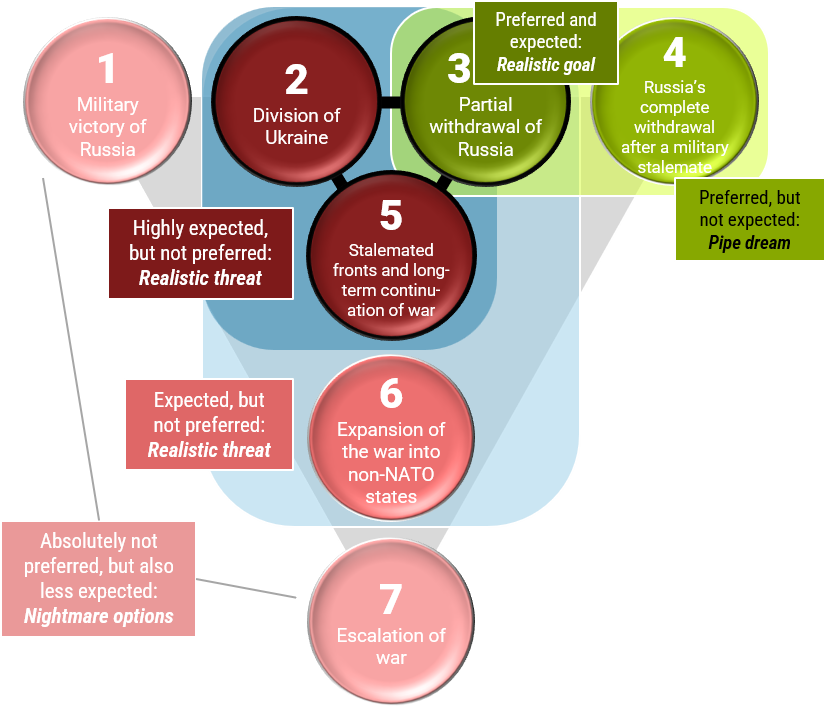
In the first step, seven possible developments in the Russia-Ukraine war through mid-2023 were positioned on a scenario map. The two central dimensions describe, first, possible outcomes of the war – from a Russian victory to a complete Russian withdrawal – and, second, the course of the conflict, ranging from a frozen conflict to regional expansion and escalation. These short-term scenarios were then linked to the long-term New Global Scenarios in order to make shifts in core dimensions such as systemic rivalry, globalisation, the role of state actors and international cooperation visible.
Scenario overview
- Military victory of Russia (Scenario 1): Russia prevails militarily and establishes a new geopolitical balance of power favouring authoritarian states.
- Division of Ukraine (Scenario 2): A ceasefire results in a lasting division of Ukraine and new spheres of influence between Russia and the West.
- Partial withdrawal of Russia (Scenario 3): Russia withdraws partially. The conflict remains unresolved but opens up prospects for negotiations and closer Western integration of the remaining Ukrainian territory.
- Russia’s complete withdrawal (Scenario 4): Ukraine’s territorial integrity is restored. This is regarded as a particularly desirable scenario, but one considered relatively unlikely.
- Entrenched conflict (Scenario 5): The war develops into a long-term war of attrition with persistent military and economic burdens.
- Expansion of the war (Scenario 6): The conflict spreads to additional states without causing direct military confrontation between Russia and NATO.
- Escalation of war (Scenario 7): Direct confrontation between Russia and NATO, or the use of new weapons systems, substantially worsens the security situation.
The results show that a prolonged war of attrition, a partition of Ukraine and a partial Russian withdrawal were regarded as the most plausible short-term developments. At the same time, long-term expectations shift markedly towards stronger geopolitical systemic rivalry: scenarios characterised by intensive international cooperation lose relevance, while power-based bloc formation, regional conflicts and a growing role for state actors gain importance. The “New Value Blocs” scenario receives particularly strong additional support from the Ukraine Stress Test.
The Ukraine Stress Test illustrates how closely short-term crises and long-term future developments are connected. The study is not intended as a forecast, but as a strategic foresight tool. It helps companies, organisations and public institutions test the robustness of their strategies against geopolitical uncertainty and consider possible effects on markets, supply chains, security, international cooperation and globalisation at an early stage.