While Volume I describes how retail offer communication could change, Volume II shifts the focus to strategic action. The central question is how retailers can further develop their marketing and value propositions. The strategy patterns are explicitly not recommendations or best practices. Instead, they are consistent future visions of possible corporate strategies, each offering a different response to the challenges posed by tomorrow’s marketing worlds.
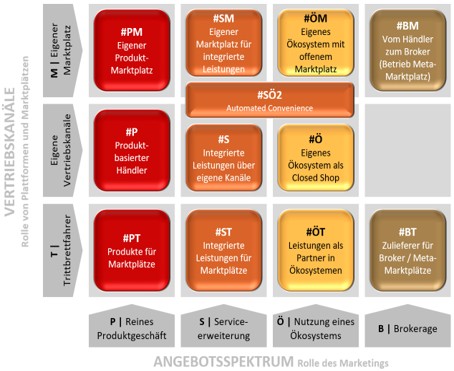
The twelve strategy patterns are brought together in a strategy map structured by two core dimensions. The first distinguishes strategies according to the breadth of their offerings and value propositions – from pure product business and service expansion to ecosystems and brokerage models. The second describes the role of sales channels, platforms and marketplaces – from proprietary sales channels and the use of third-party platforms to operating a company’s own marketplace. Combining these two dimensions produces twelve distinct strategic archetypes for the future of marketing.
The strategy patterns
- Product-based dealer (Strategy Pattern P): The retailer focuses on products, prices and conventional marketing instruments. Proprietary sales channels and traditional forms of customer loyalty shape the strategy.
- Own product marketplace (Strategy Pattern PM): The company complements and markets its own products through a marketplace that it operates itself. The aim is to broaden the assortment and strengthen the company’s own brand platform.
- Products for marketplaces (Strategy Pattern PT): The retailer primarily uses external platforms and marketplaces as sales channels. Reach and efficient product distribution are the main priorities, while direct access to customers remains limited.
- Integrated offerings through own channels (Strategy Pattern S): Products are consistently supplemented by services. Customer satisfaction, convenience and personal advice form the core of the strategy.
- Own marketplace for integrated offerings (Strategy Pattern SM): A proprietary marketplace combines products, services and a high-quality shopping experience under a strong retail brand. Omnichannel delivery and customer experience become the main differentiators.
- Integrated offerings for marketplaces (Strategy Pattern ST): Products and services are offered through external platforms. The retailer combines the reach of marketplaces with a strong customer focus and additional services.
- Automated convenience (Strategy Pattern SÖ2): Digital services, automation and data-driven personalisation create maximum convenience for customers. Convenience develops into a value proposition in its own right.
- Own ecosystem as a closed shop (Strategy Pattern Ö): The retailer develops a comprehensive service ecosystem around its product range and keeps the customer relationship largely within its own channels. Data, services and personal support are closely integrated.
- Own ecosystem with an open marketplace (Strategy Pattern ÖM): The retailer opens its ecosystem to partners and develops it into a marketplace. Customers benefit from an integrated range of offerings, while the retailer provides the central platform.
- Offerings as a partner in ecosystems (Strategy Pattern ÖT): The retailer integrates its products and services into existing platform and partner ecosystems. Cooperation and shared value creation take centre stage.
- Supplier to brokers / meta-marketplaces (Strategy Pattern BT): Retailers systematically align their offerings with brokers and meta-marketplaces. Direct customer relationships become less important than efficient supplier relationships.
- From dealer to broker (operating a meta-marketplace) (Strategy Pattern BM): The company becomes a broker itself and orchestrates a meta-marketplace offering data-driven advice, AI-supported personalisation and comprehensive platform services.
Although these strategy patterns are future scenarios rather than exact representations of current corporate strategies, many of their elements can already be found in retail. Decathlon, for example, illustrates integrated offerings through proprietary channels (#S), while Globetrotter’s expanded service portfolio shows elements of an own ecosystem (#Ö). Through their partner programmes, Zalando and About You are moving towards open marketplace models (#ÖM), allowing external retailers to offer their products. Idealo displays features of a brokerage approach (#BM) by bringing together and comparing offers from different retailers. At the same time, many retailers use external platforms such as Amazon or Otto Marketplace and therefore pursue strategies as marketplace providers (#PT or #ÖT). These examples show that many elements of the strategy patterns are already visible today, even though they rarely appear in their complete archetypal form.
The assessment of the strategy patterns also points to a clear development in retail. Product-oriented strategies and conventional sales channels still dominate today, but the experts expect a stronger customer focus, expanded service offerings and a growing role for platforms and ecosystems in the future. In the longer term, strategies that combine integrated ecosystems, data-driven services and new forms of customer relationships appear particularly attractive.
The strategy patterns provide retailers with a structured frame of reference for developing their marketing and corporate strategies. Combined with the marketing worlds from Volume I, they make it possible to systematically connect different future scenarios with suitable strategic options and develop robust courses of action for retail offer communication.