A scenario process by Bau- und Liegenschaftsbetrieb Nordrhein-Westfalen (BLB NRW)
Bau- und Liegenschaftsbetrieb Nordrhein-Westfalen (BLB NRW), whose responsibilities include developing future-ready university infrastructure, conducted a foresight process together with ScMI AG and an interdisciplinary group of experts. The project explored alternative university worlds with a time horizon of around ten years. Using the Scenario Management methodology, the team developed ten scenarios and positioned them on a Map of the Future. The experts then assessed the scenarios in terms of the present situation and expected future and derived seven key conclusions for the future development of education.
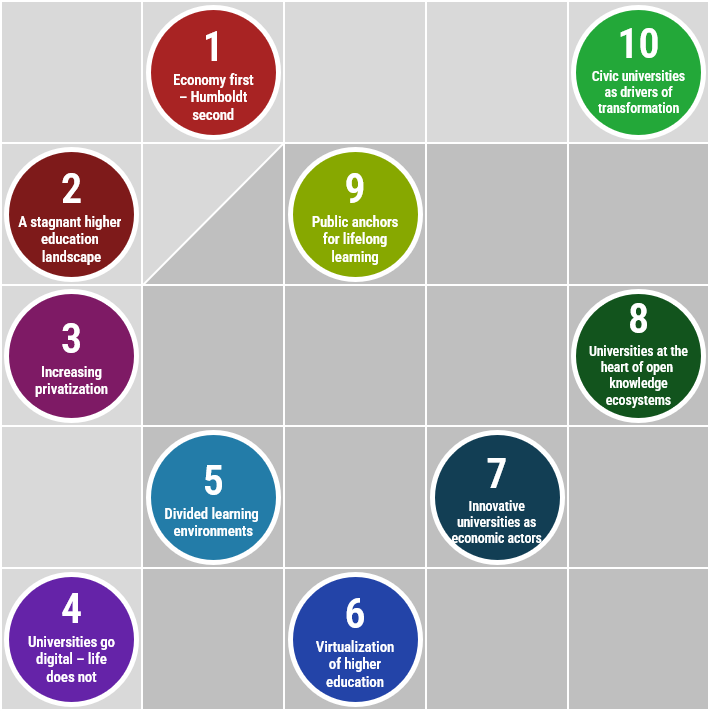
Which scenarios emerge on the Map of the Future?
- Economy first – Humboldt second (Scenario 1): A society driven by economic objectives increases education budgets and directs universities towards innovation, research and elite education. Participation and subjects without direct economic relevance recede into the background.
- A stagnant higher education landscape (Scenario 2): Amid an economic downward spiral, change and reform are viewed critically. The forces of inertia that dominate society are also reflected in German higher education, where structural barriers prevent broader participation. Germany becomes highly unattractive as a higher education location.
- Increasing privatization (Scenario 3): Policymakers respond to global competition between locations with privatisation and greater economic freedom. Universities are increasingly privately funded and operated. Yet this does not lead to fundamental reform: institutions continue to focus on initial higher education, align their programmes with short-term improvements in employability and ultimately reinforce the competitive weakness of the German higher education system.
- Universities go digital – life does not (Scenario 4): Learning, and university teaching in particular, is dominated by digital online formats. This reduces costs, but participation remains limited. Social interaction continues to take place in person, while university towns increasingly become places where students live rather than where university life itself takes place.
- Divided learning environments (Scenario 5): Economic growth and innovation go hand in hand with social division. The same divide emerges in higher education, where German universities concentrate on economically relevant subjects and elite education while broader participation is neglected.
- Virtualization of higher education (Scenario 6): Business and society are highly virtualised. Digital universities and AI-generated content become defining features. Students can study from almost anywhere, university towns lose importance and physical infrastructure is scaled back significantly. Universities provide very few physical learning spaces.
- Innovative universities as economic actors (Scenario 7): In a prosperous environment, private investment becomes the main driver of university funding. As higher education becomes increasingly commercialised, even public universities develop into economic actors that market and monetise their knowledge.
- Universities at the heart of open knowledge ecosystems (Scenario 8): Education becomes a central driver of society. Universities evolve into integrated centres of expertise and important hubs within regional knowledge ecosystems. Face-to-face discourse, exchange and in-person teaching remain important.
- Public anchors for lifelong learning (Scenario 9): Supported by increased public funding, universities assume greater responsibility towards society. They become central providers of lifelong learning for a wide range of stakeholders and social groups.
- Civic universities as drivers of transformation (Scenario 10): In a post-growth society, paid employment becomes less important and civic universities focus on broadly accessible, intrinsically motivated and self-directed education. Economic objectives, research and innovation recede into the background.
Readers can look forward to detailed descriptions of the future scenarios and an extract from the scenario assessment, which will soon be available to download.