Building on the New Horizons scenarios from the predecessor project Germany 2030, the D2030 initiative extended the time horizon to 2045 in a new project and focused on potentially disruptive future visions that were assessed positively. The year 2045 was chosen because the German government has committed to transforming Germany into a climate-neutral country by then. The guiding question was therefore: “Which futures could we want?”
The scenarios were developed as part of an open-foresight project involving a scenario team of around 50 people. The process was directed by a core team that included Dr Alexander Fink and Hanna Rammig from ScMI. Participants included numerous futures researchers and experts from academia, business, public administration and civil society. The process also featured participatory public events and online dialogues, enabling further interested participants to contribute to the discussion.
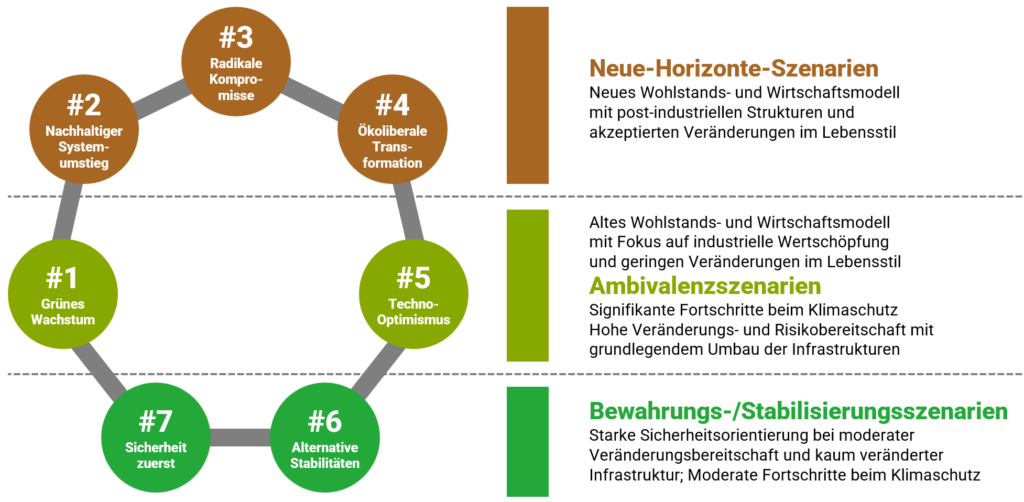
Seven target scenarios
- Green growth (Scenario 1): People are willing to change, but wary of radical breaks. Government takes a leading role and uses missions to drive the transformation towards a green industrial economy that becomes a global model. Participation, consensus and balance are important.
- Sustainable system transition (Scenario 2): Germany moves away from growth and competition and pursues radical transformation, giving priority to climate action. Regional value creation, a basic income, changing lifestyles and new infrastructure characterise the system transition.
- Radical compromises (Scenario 3): Germany successfully transforms into a sovereign economy that competes on global markets beyond conventional growth. Policymakers orchestrate jointly developed missions that unite an opportunity-oriented and diverse society.
- Eco-liberal transformation (Scenario 4): In a world shaped by digital value creation, Germany successfully transforms towards a post-industrial economic model. Societal openness and individual and entrepreneurial freedom provide the foundation, while government concentrates on setting the framework.
- Techno-optimism (Scenario 5): Supported by visionary companies and deep-tech innovation, Germany successfully transfers its traditional strength in industrial value creation to the digital world. Breakthroughs in green technology are the key to addressing the climate crisis.
- Alternative forms of stability (Scenario 6): Germany faces up to global and societal realities. Policymakers concentrate on what can be achieved by consensus, including on climate and transformation. Individual responsibility gains importance, while civil-society structures take on numerous tasks.
- Security first (Scenario 7): The traditional centre of society remains strong and seeks security. Prosperity, social balance and stability are higher priorities for an actively regulating government than transformation and climate action. Strong core industries continue to provide the foundation.
A detailed assessment by the interdisciplinary scenario team was combined with a further survey that received more than 150 responses. This made it possible to examine the current situation as well as desired and expected changes in relation to the seven scenarios. Several findings emerged from the assessment:
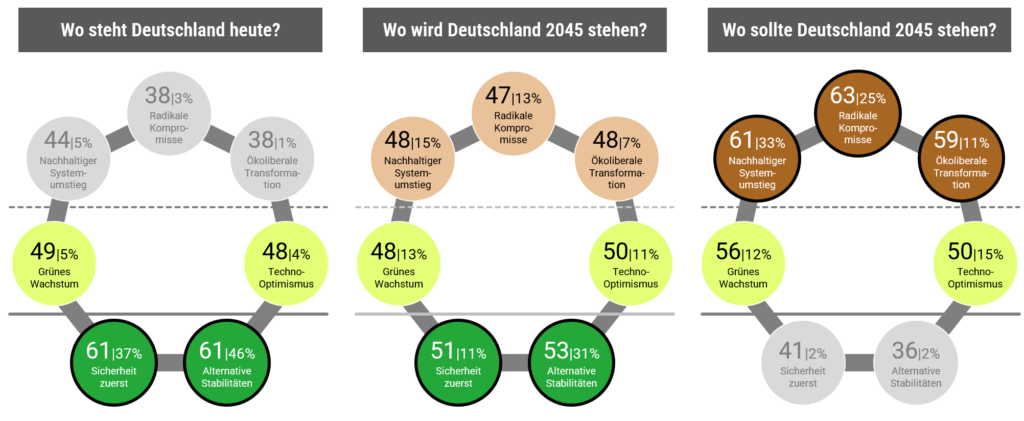
- There are not only several paths into the future, but also competing target scenarios. Political and societal discourse should therefore look beyond short-term measures and give greater attention to long-term visions and target images.
- Most people surveyed as part of the study want fundamental changes of the kind described in the New Horizons scenarios.
- Seven conditions would need to be created to achieve the most desired New Horizons scenarios, including consistent climate policy, a new economic model, changed lifestyles and new forms of participation.
- The study identified a further twelve trade-offs for which there is no unambiguously right or wrong answer from a transformation perspective, including the tension between national sovereignty and global openness in economic relations.
- Transformation will succeed only if we learn to develop long-term viable solutions for positions that currently appear incompatible – so-called radical compromises.
The full study report can be downloaded here. Further detailed findings from the open-foresight process are available on the D2030 website. Please contact us for further information about using the scenarios in your own project work or arranging talks and presentations.