An interdisciplinary scenario team of 31 experts from across Bavaria’s winter tourism sector explored key questions about its future. Through a series of workshops, the team mapped the relationships and interactions between climate change and winter tourism, identifying 21 key factors shaping the sector’s future development. These key factors were examined in a detailed network analysis, and several alternative future projections were developed for each one. The projections were then combined into seven internally consistent scenarios depicting possible futures for winter tourism up to 2050.
The scenarios span a broad spectrum, from snow-dependent winter offerings to sustainable, year-round tourism concepts. Social, economic and environmental dimensions structure the Map of the Future. The resulting future visions provide a valuable basis for strategic decisions aimed at securing a resilient and sustainable future for winter tourism in Bavaria.
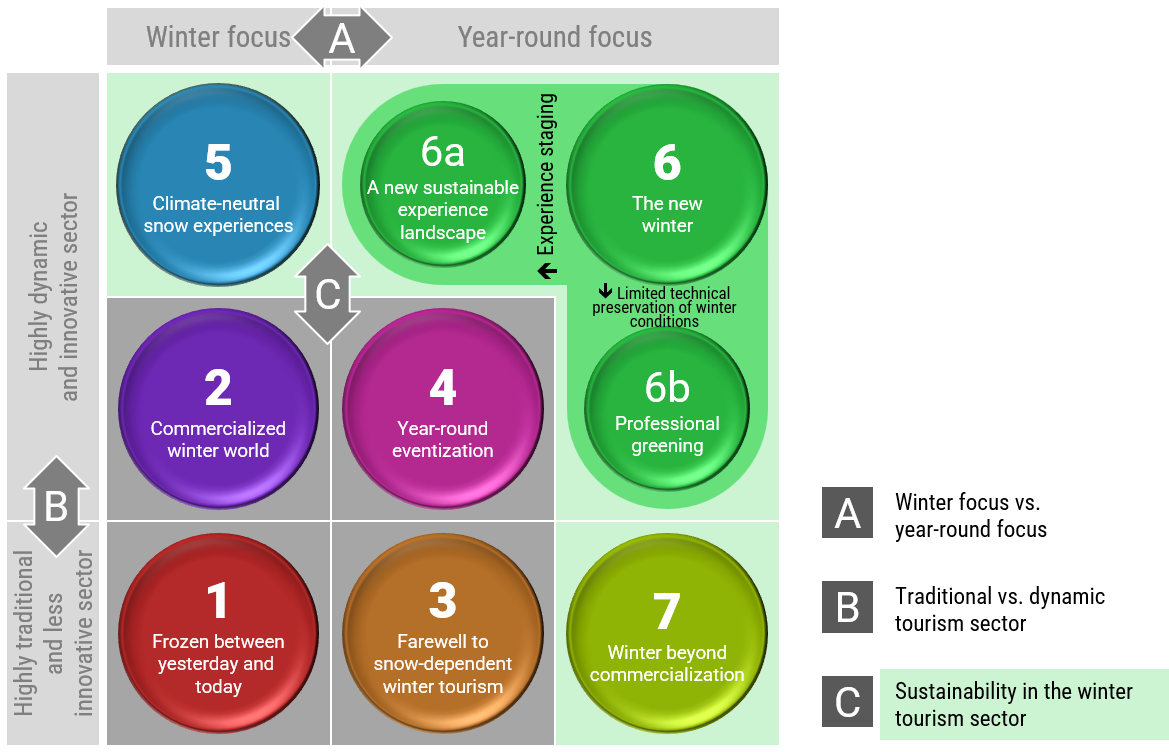
Which scenarios emerge on the Map of the Future?
- Frozen between yesterday and today (Scenario 1): The sector remains stuck in old ways of thinking. A lack of snow prompts visitors to switch destinations, yet no long-term measures are taken to transform the sector.
- Commercialized winter world (Scenario 2): Investments in climate-adaptation infrastructure and technology that recreates winter conditions maintain the appeal of winter sports. Sustainability remains a secondary consideration.
- Farewell to snow-dependent winter tourism (Scenario 3): Winter tourism loses popularity, while leisure activities that do not depend on snow gain importance.
- Year-round eventization (Scenario 4): As the traditional winter season becomes less important, the sector focuses on a wide range of snow-independent, year-round experiences with an emphasis on events.
- Climate-neutral snow experiences (Scenario 5): High-tech solutions create a sustainable “winter wonderland” in response to society’s high expectations for sustainability.
- The new winter (Scenario 6): Winter tourism becomes part of a broader transformation towards sustainable, year-round tourism. Neither a focus on winter nor a reliance on snow remains central. The map distinguishes two variants: A new sustainable experience landscape (6a) and Professional greening (6b).
- Winter beyond commercialization (Scenario 7): Tourism deliberately shifts towards a slower pace, with resource-efficient, year-round offerings centred on sustainability and relaxation.
Following scenario development, the future visions were jointly assessed and mapped according to expectations and preferences. The results show that the greatest opportunities lie in scenarios that move beyond the traditional winter focus and develop winter tourism as part of sustainable, year-round offerings. At the same time, there is no single future to aim for. Different development pathways can succeed if the tourism sector embraces innovation and takes an active role in shaping change.
The study therefore shows that the future of winter tourism depends not only on climate change, but above all on the strategic decisions of the stakeholders involved. The scenarios create a shared understanding of possible developments and encourage dialogue about desirable futures. They also provide a robust basis for preparing regions, destinations and tourism offerings for different future trajectories at an early stage.