Rail transport is undergoing profound change. While it is expected to play a central role in the transition towards sustainable mobility and climate neutrality, the sector is also confronted with ageing infrastructure, skilled-labour shortages, major investment needs, digitalisation and changing mobility behaviour. Against this backdrop, H&Z and ScMI AG initiated a cross-industry foresight process involving representatives from industry, infrastructure, mobility providers, politics and other parts of the rail value chain. The aim was to systematically investigate possible development pathways for rail transport and derive strategic orientation for different actors.
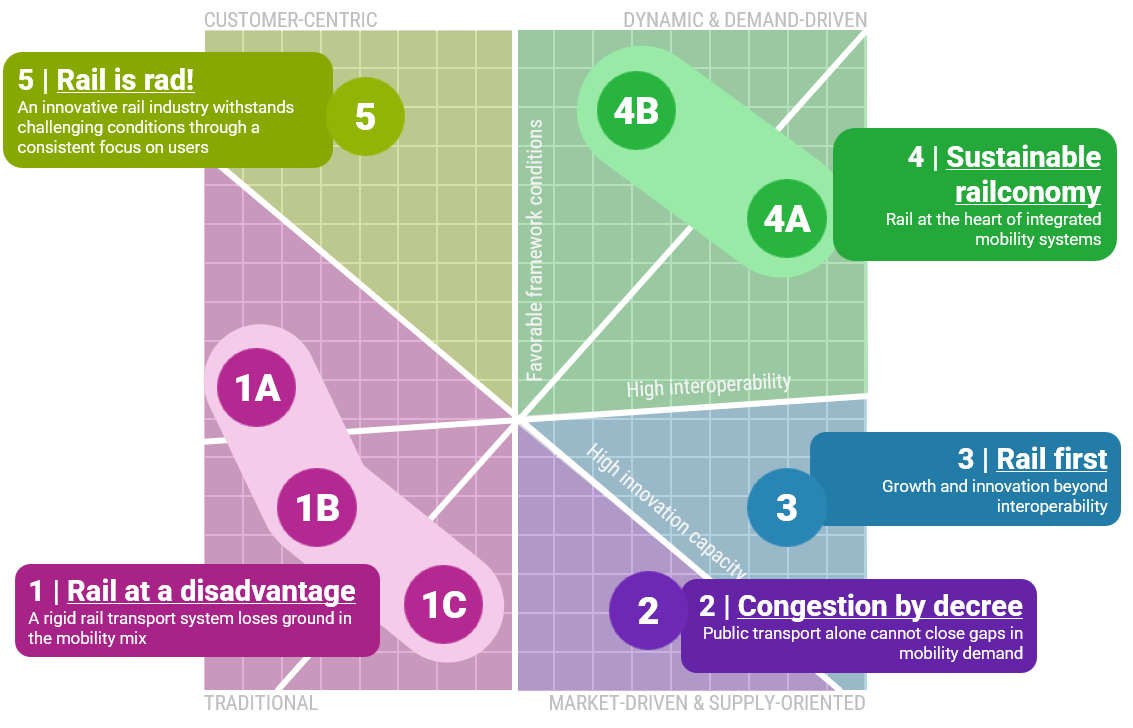
The scenario process first identified the main drivers influencing rail transport and consolidated them into key factors. Alternative future projections were then developed and combined into consistent scenarios, which were positioned on a map of the future. Particular attention was paid to fundamental uncertainties such as the role of rail in the future mobility mix, the degree of digitalisation, automation and interoperability, and the political and social conditions for sustainable mobility.
• Rail at a Disadvantage (Scenario 1): Rail loses importance in the mobility mix and remains trapped in outdated structures.
• Gridlock by Decree (Scenario 2): Political support alone is not enough to meet growing mobility demand through public transport.
• Rail First (Scenario 3): Rail grows through digitalisation and sustainability, but remains only partially integrated with other modes of transport.
• Sustainable Railconomy (Scenario 4): Rail develops into the backbone of an integrated, intelligently connected mobility system.
• Rail Is the Real Deal (Scenario 5): An innovative and consistently customer-oriented rail sector succeeds even under demanding competitive conditions.
The subsequent scenario assessment reveals a clear difference between the present and the future. Today’s situation is still strongly characterised by scenarios in which rail loses competitiveness or falls short of its potential. For the future, by contrast, the participating experts expect rail to play a substantially stronger role within integrated mobility systems. Futures that combine digitalisation, interoperability, innovation and customer orientation are rated as especially desirable. On this basis, the study analysed opportunities and risks for different stakeholders and derived robust options for action across a range of future developments.
The study treats the scenarios as a starting point for strategic dialogue about the future of rail. They help companies, infrastructure operators, policymakers and other actors align their strategies with different future developments, assess options for action and make robust decisions early for a future-ready mobility ecosystem.