The mechanical engineering industry is facing profound change. Artificial intelligence is becoming a key technology and is transforming products, production processes, service offerings and business models. At the same time, geopolitical developments, shortages of skilled labour, sustainability requirements and new competitors are reshaping the sector’s future environment. Which of these developments will prevail by 2035 remains uncertain. This is precisely why conventional forecasts are not enough. Future scenarios open up a structured space for thinking about different development pathways and preparing robust strategic decisions.
The study developed as part of the AISceMa research project presents eight consistent future scenarios describing possible transformations of the mechanical engineering industry in the AI era and offering companies guidance for their strategic positioning. The scenarios were developed in a collaborative process with owl maschinenbau and representatives of various mechanical engineering companies, who contributed their perspectives and experience to the scenario process. At the same time, the study also served as a methodological component of the research project: a range of AI tools and AI-supported methods were deliberately used to support individual steps in scenario development and to test the interplay between human expertise and artificial intelligence in strategic foresight.
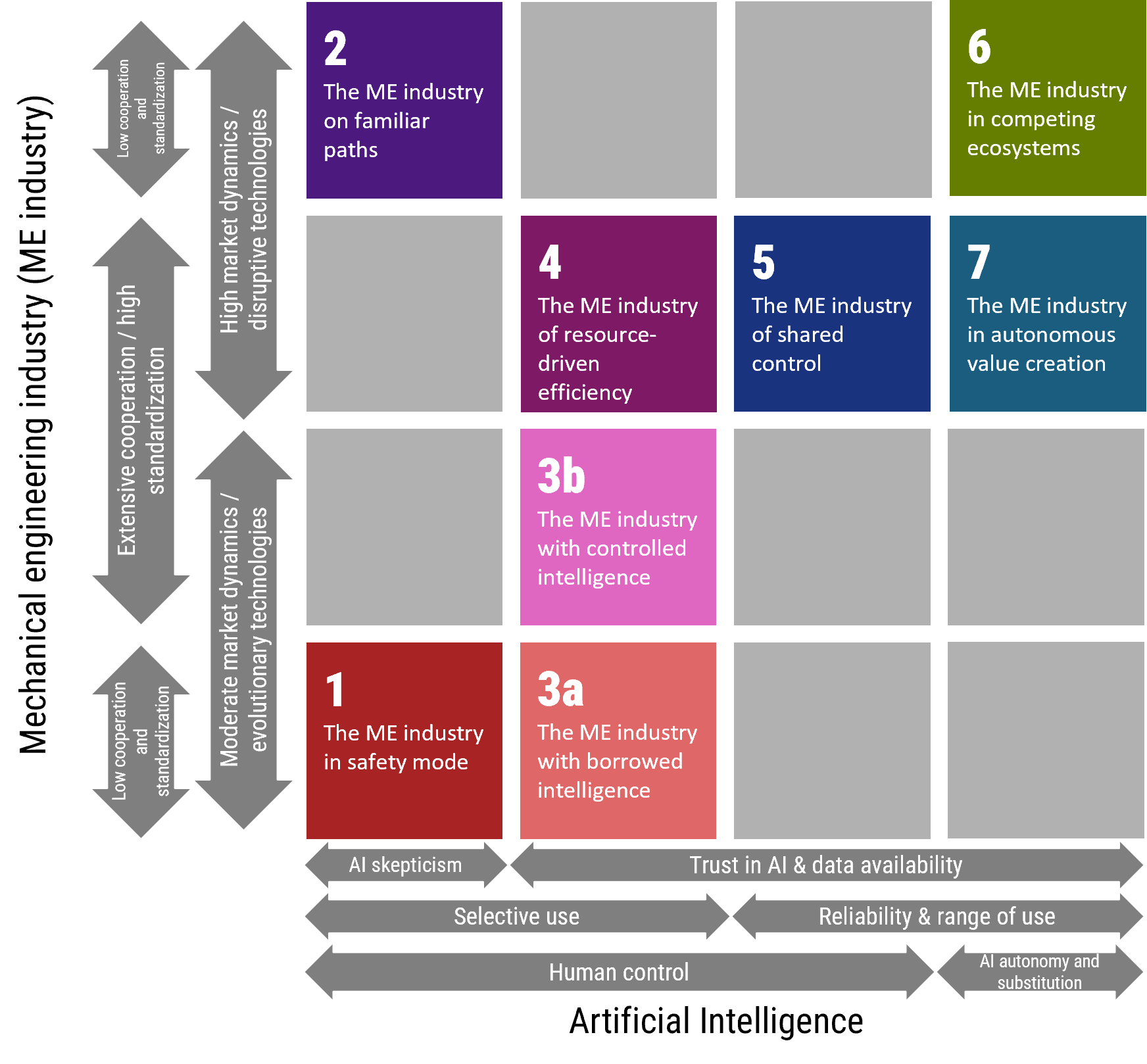
The scenarios at a glance
- The mechanical engineering industry in security mode: AI is used only selectively and under strict security requirements. Companies preserve their strengths, but lose innovation momentum.
- The mechanical engineering industry on familiar paths: AI supports existing processes and products, but barely changes the business model. Development remains evolutionary.
- The mechanical engineering industry with borrowed intelligence: External AI platforms enable rapid progress, but increase dependence on technology providers and their data ecosystems.
- The mechanical engineering industry with controlled intelligence: Companies rely on their own AI and data infrastructures. They gain sovereignty, but this requires higher investment and greater integration effort.
- The mechanical engineering industry driven by resource efficiency: Resource efficiency, durability and the circular economy shape competition. Service and lifecycle models become significantly more important.
- The mechanical engineering industry with shared control: AI is used extensively, but remains embedded in clear responsibility and governance structures. Humans and AI work closely together.
- The mechanical engineering industry in competing system worlds: Platforms and digital ecosystems shape the market. Performance increases, but so do dependencies between different system worlds.
- The mechanical engineering industry with autonomous value creation: Highly autonomous systems take over the planning, control and optimisation of industrial processes. Value creation increasingly shifts into data-driven ecosystems.
The subsequent scenario assessment evaluates the future scenarios from three perspectives: today’s situation, expected developments through 2035 and the preferred future. The results show that the mechanical engineering industry currently lies mainly between cautious use of AI and reliance on external AI solutions. By 2035, the participating experts expect significantly greater AI maturity and much stronger integration of data and AI into industrial processes. The mechanical engineering industry with shared control emerges as a particularly attractive future pathway, combining powerful AI with clear responsibilities and human decision-making authority. At the same time, the assessment makes clear that future development remains subject to considerable uncertainty. This is precisely why the scenarios provide a valuable basis for developing strategies that are not geared to one single future, but are prepared for different development pathways.